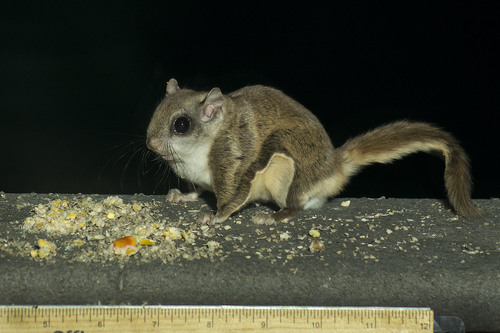
Northern Flying Squirrel
Glaucomys sabrinus
A silent glider of the midnight forest, the Northern Flying Squirrel turns the canopy into a playground under the cover of darkness. While rarely seen by the naked eye, these social, big-eyed acrobats are common residents of the northern woods.
Quick Identification
Size
Total length of 25–37 cm (10–15 in); weight ranging from 75–140 g (2.6–4.9 oz).
Colors
Cinnamon-brown to light brown upper fur; belly fur is grey at the base with creamy-white tips; large, dark nocturnal eyes.
Key Features
- Furry membrane (patagium) extending from wrists to ankles
- Large, dark eyes optimized for night vision
- Flattened, rudder-like tail used for steering during glides
- Small, rounded ears and extremely soft, dense fur
When You’ll See Them
Geographic range
Where Does the Northern Flying Squirrel Live?
Native to the North American continent, the Northern Flying Squirrel thrives in the vast boreal forests and mountainous regions. Its core range spans from the treeline in Alaska across nearly all of Canada to the Atlantic coast. In the United States, they are found throughout the Pacific Northwest, the northern Great Lakes region, and extending south through the high-elevation corridors of the Rocky Mountains and the Appalachian chain.
Basemap © OpenStreetMap contributors
Behavior
Northern Flying Squirrels are the nocturnal acrobats of the forest, emerging after dusk to glide silently between trees. Using a specialized fold of skin called a patagium, they can glide for over 45 meters in a single leap, using their flat tails as a rudder to steer and navigate around branches. Unlike most squirrels, they are clumsy on the ground and rarely descend to the forest floor except to forage for specific fungi or to move between disconnected patches of trees.
These squirrels are remarkably social, especially during the cold winter months. To survive freezing temperatures in the northern parts of their range, they often huddle together in shared tree cavities, with up to a dozen individuals sharing body heat. They are much less aggressive than their daytime-active cousins and spend their nights foraging for lichens and truffles, communicating with one another through high-pitched chirps and ultrasonic vocalizations.
EverydayEarth exclusive
Camera Tips
To successfully capture Northern Flying Squirrels, you must look up rather than down. Mount your camera on the trunk of a mature tree—conifers like spruce or fir are ideal—at a height of 5 to 7 feet. Angle the camera slightly upward or across to a neighboring trunk where you see plenty of lichen growth. Because they are strictly nocturnal, a camera with high-quality infrared (IR) night vision is essential. Use a 'No-Glow' or 'Black Flash' model if possible to avoid startling them, though they are generally less shy than other nocturnal mammals.
Attracting them to your camera's field of view is best achieved with scent and food lures. Smear a 'squirrel paste' made of peanut butter, molasses, and crushed walnuts directly onto the bark in front of the lens. They are also highly attracted to suet cages filled with high-fat nut blends. Since these squirrels are fast and often land with a sudden 'thump,' set your camera to its fastest trigger speed and use a burst mode of 3-5 photos or a short 10-second video clip to ensure you capture the action rather than just a blurry tail.
In the winter, look for 'huddle trees'—cavities in old trees where you might spot multiple squirrels emerging at dusk. If you have a backyard bird feeder, consider leaving it out overnight; while they are fungi specialists, they will readily visit sunflower seed stations under the cover of darkness. Positioning a camera near a dripping water source during dry spells is another excellent way to capture them, as they must hydrate after eating dry lichens and bark.
Similar Species
Species that look similar or are commonly confused with Northern Flying Squirrel.
Frequently Asked Questions
Record Northern Flying Squirrel at your habitat
Connect a camera to start building your own species record — AI identifies every visitor automatically.