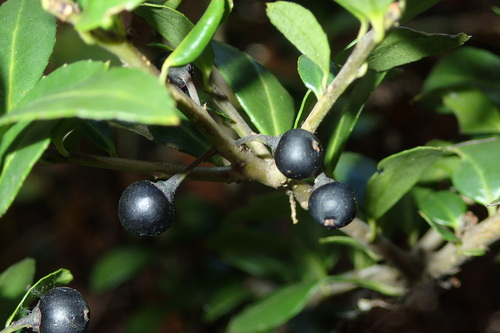
Japanese holly
Ilex crenata
A lush, spineless evergreen that trades the typical holly prickle for elegant, boxwood-like leaves. Japanese holly is a year-round sanctuary, offering dense architectural beauty for your garden and a vital winter larder for songbirds.
Quick Identification
Size
3 to 10 feet (0.9 to 3 meters) tall, though some varieties reach 15 feet; spread is typically equal to height
Colors
Lustrous dark green upper leaf surfaces, lighter dull green undersides; small white flowers; glossy black berries
Key Features
- Small, oval leaves with rounded teeth (crenate) toward the tip
- Alternate leaf arrangement with no spines
- Inconspicuous 4-lobed white flowers in spring
- Small, pea-sized black drupes (berries) on female plants
- Dense, multi-branched evergreen structure
When You’ll See Them
Behavior
Japanese holly is a slow-growing, broadleaf evergreen shrub that serves as a cornerstone of both manicured landscapes and wild thickets. Unlike its prickly cousins, this species is noted for its soft, boxwood-like appearance and remarkable versatility. It is a dioecious plant, meaning individual shrubs are either male or female; only the females produce the signature black berries that provide a vital winter food source for backyard visitors.
In a backyard ecosystem, Japanese holly functions as a high-density apartment complex for wildlife. Its tight, interlocking branches provide exceptional thermal cover during winter storms and secure nesting sites in the spring. While humans value it for its ability to withstand heavy pruning and urban pollution, local fauna see it as a safe haven from predators like hawks and outdoor cats.
EverydayEarth exclusive
Camera Tips
To capture the best action around your Japanese holly, position your camera at a mid-range height, roughly 3 to 4 feet off the ground, aimed at a cluster of berries or a clear opening in the branches. If you are using an AI-powered camera like those from EverydayEarth, look for 'flight paths' where birds enter and exit the shrub. Because the foliage is so dense, setting your camera to a higher sensitivity for motion can help trigger captures before the subject disappears into the interior of the plant.
During the late winter months, when food sources are scarce, focus your lens on the female plants laden with black drupes. This is the prime time to record foraging behavior from species like Cedar Waxwings, American Robins, and Northern Mockingbirds. Use a macro lens or a close-up focus setting if your camera allows, as the tiny white flowers in late spring are magnets for specialized pollinators, including solitary bees and hoverflies that are often missed by the naked eye.
Lighting is a critical factor when photographing Japanese holly because its dark, glossy leaves can cause significant glare or 'hot spots' in direct midday sun. For the most professional-looking captures, configure your camera to prioritize early morning or late afternoon light, which brings out the rich texture of the crenate leaf edges. If your camera has adjustable exposure settings, consider underexposing by a half-stop to prevent the highlights on the waxy leaves from blowing out.
For those interested in terrestrial visitors, place a camera at the base of the holly. The low-hanging branches create a 'skirting' effect that provides a sheltered corridor for small mammals like chipmunks or even amphibians seeking damp shade. Ensure the area immediately in front of the lens is clear of low-swinging twigs, as the evergreen leaves of the Japanese holly are heavy enough to trigger motion sensors during a stiff breeze, potentially filling your SD card with 'ghost' videos.
Similar Species
Species that look similar or are commonly confused with Japanese holly.
Frequently Asked Questions
Record Japanese holly at your habitat
Connect a camera to start building your own species record — AI identifies every visitor automatically.