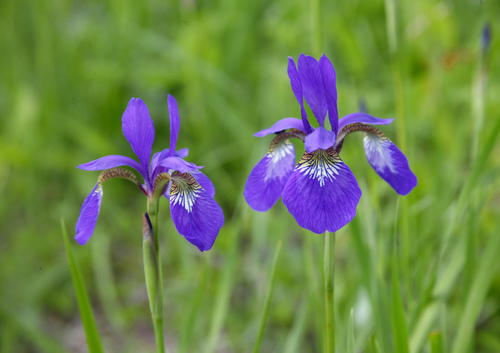
Japanese Iris
Iris sanguinea
Transform your garden into a regal display with the deep violet hues and elegant architecture of the Japanese Iris. A master of the marsh and the meadow, this stunning perennial is a magnet for early-summer pollinators.
Quick Identification
Size
Height: 12-36 inches (30-90 cm); Flower diameter: 3-5 inches (8-13 cm)
Colors
Rich reddish-purple to deep blue-violet; petals often feature a white or yellow 'signal' patch at the base with dark veining; foliage is a consistent grey-green.
Key Features
- Unbranched flowering stems rising above foliage
- Sword-shaped, narrow grey-green leaves
- Three drooping 'falls' and three upright 'standards'
- Distinctive intricate veining on the base of the petals
When You’ll See Them
Behavior
The Japanese Iris is a hardy perennial that grows in dense, clumping rhizomes. Unlike some of its more aggressive garden relatives, it maintains a tidy, upright posture that makes it a favorite for structured landscapes. In the wild, it acts as a vital early-summer nectar source, attracting various long-tongued bees and butterflies that are uniquely equipped to navigate its complex floral architecture.
As the plant matures, the clumps expand outward, creating a lush green backdrop even when not in bloom. Its flowers are relatively short-lived individually, typically lasting only a few days, but a healthy clump will produce a succession of blooms over several weeks. It is particularly well-adapted to damp environments, often found naturally stabilizing the edges of ponds or marshy meadows.
EverydayEarth exclusive
Camera Tips
To capture the stunning architectural detail of the Japanese Iris, place your camera at a mid-level height, roughly 18 to 24 inches off the ground. This 'bee's-eye view' allows the lens to look directly into the throat of the flower and capture the intricate veining on the falls. Avoid pointing the camera straight down from a high tripod, as this flattens the flower's natural three-dimensional elegance.
Lighting is the most critical factor for this species. Deep purple and blue-purple petals can often 'clip' or lose detail in harsh midday sun, appearing as a solid dark blob on camera. Set your capture schedule for the 'golden hours'—shortly after sunrise or just before sunset. The soft, angled light will highlight the velvety texture of the petals and the crystalline structure of the nectar signals. If your camera allows for exposure adjustment, slightly underexposing the shot can help preserve the rich saturation of the purple hues.
Since these plants are stationary, they are the perfect subjects for time-lapse photography. Set your AI camera to take a photo every 15 to 30 minutes during the peak blooming days in June. When stitched together, you can witness the dramatic 'unfurling' of the standards and falls, a process that looks almost choreographed. This is a great way to use your backyard tech to document the transition from a tight, spear-like bud to a fully open blossom.
Consider the background of your shot to make the Japanese Iris pop. Positioning the camera so that a darker evergreen shrub or a shaded area of the garden is behind the flower will create a natural contrast that emphasizes the iris's vibrant colors. If you are using an AI-trigger camera, ensure the sensitivity is high enough to catch the movement of pollinators like swallowtail butterflies or bumblebees, which frequently visit these blooms, adding a dynamic element to your still-life plant photography.
Similar Species
Species that look similar or are commonly confused with Japanese Iris.
Frequently Asked Questions
Record Japanese Iris at your habitat
Connect a camera to start building your own species record — AI identifies every visitor automatically.