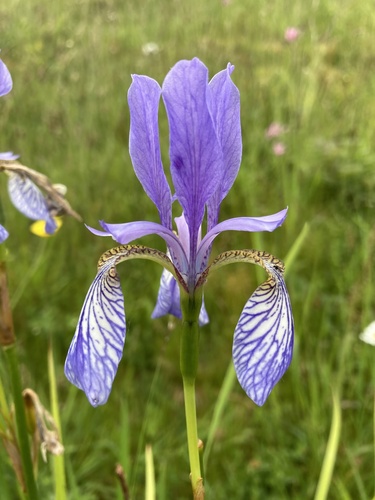
Siberian Iris
Iris sibirica
With its elegant, sword-like foliage and vivid violet blooms, the Siberian Iris is a timeless favorite for backyard observers. This hardy perennial transforms damp garden corners into a bustling sanctuary for early-summer pollinators.
Quick Identification
Size
Height: 60-120 cm (24-48 inches); Spread: 60-90 cm (24-36 inches)
Colors
Deep violet-blue, lavender, or white; falls feature a white or yellow 'signal' with dark purple veining
Key Features
- Narrow, grass-like green foliage
- Hollow flowering stems that rise above the leaves
- Beardless blossoms with three upright 'standards' and three drooping 'falls'
- Forms dense, architecturally striking clumps
When You’ll See Them
Behavior
Siberian Irises are resilient, long-lived perennials that bring a sense of refined elegance to any backyard ecosystem. Unlike their more flamboyant 'Bearded' cousins, these plants grow in tight, neat clumps that remain attractive even after the flowering season has ended. They are structurally robust, with slender leaves that provide excellent cover for ground-dwelling insects and small amphibians during the heat of the day.
As the blooms emerge in late spring, the plant becomes a high-traffic hub for local pollinators. Because the flowers are beardless and have a more delicate structure, they are especially popular with bumblebees and hoverflies that can easily navigate the smooth petals to reach the nectar. They are also known for their extreme hardiness, often being one of the first major floral displays to signal the shift from spring into summer.
EverydayEarth exclusive
Camera Tips
To capture the stunning transformation of a Siberian Iris, time-lapse is your best friend. Position your camera on a stable tripod or garden stake about three feet from the ground, angled slightly downward to capture the buds as they begin to swell in late May. Setting the AI camera to trigger every 30 minutes will allow you to document the 'unfurling' process, which reveals the intricate veining on the falls in a way that is missed by the naked eye.
Because the Siberian Iris is a major draw for pollinators, use a high-speed shutter setting to capture the movement of bumblebees and hummingbirds. Place the camera 24 to 36 inches away from the most active blooms. For the best colors, ensure your camera is positioned to take advantage of the 'Golden Hour'—the hour after sunrise or before sunset. The low-angle light makes the violet-blue petals look almost translucent, creating a luminous 'glow' in your photos and videos.
Wind can be a challenge with the slender, grass-like leaves of the Siberian Iris, potentially causing thousands of 'false' triggers. If your camera allows for zone masking, exclude the very top of the foliage from the motion-detection area. Focus the trigger zone specifically on the flower heads where pollinators are most likely to land. In the winter, don't remove your camera; the dried, architectural seed pods look magnificent in the snow and occasionally attract small songbirds looking for leftover seeds.
Similar Species
Species that look similar or are commonly confused with Siberian Iris.
Frequently Asked Questions
Record Siberian Iris at your habitat
Connect a camera to start building your own species record — AI identifies every visitor automatically.