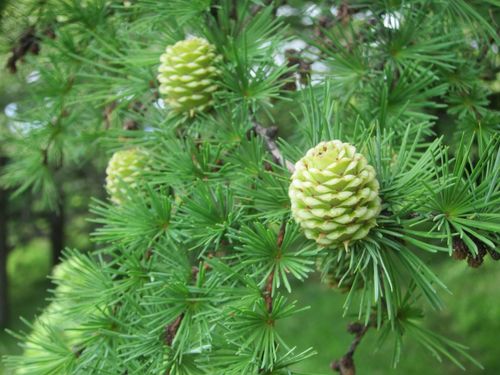
Japanese larch
Larix kaempferi
The Japanese larch is a seasonal showstopper, trading its soft blue-green needles for a crown of liquid gold every autumn. A rare deciduous conifer, it provides a shifting stage for backyard birds and a striking silhouette against the winter sky.
Quick Identification
Size
Height of 20–40 m (65–130 ft) with a trunk diameter reaching 1 m (3.3 ft).
Colors
Soft glaucous blue-green needles in summer; vibrant golden-yellow in autumn; reddish-brown bark.
Key Features
- Deciduous needles that drop in winter
- Rosette-shaped cones with scales that curve backwards
- Blue-green summer foliage with white stomatal bands
- Horizontal branches with slightly drooping tips
When You’ll See Them
Behavior
The Japanese larch is a remarkable conifer that defies the 'evergreen' stereotype by shedding its needles every autumn. Native to the volcanic slopes of Honshu, Japan, it is a hardy and fast-growing pioneer species. In a backyard or forest setting, it serves as a dynamic focal point that shifts dramatically through the seasons, providing a high-contrast backdrop for other wildlife.
During the spring, it produces delicate, rose-like cones and soft tufts of bright green needles. As a 'light-demanding' species, it quickly reaches for the canopy, creating a dappled shade that allows a rich understory to grow beneath it. This makes it a popular habitat for various insects, which in turn attracts insectivorous birds like chickadees and warblers.
EverydayEarth exclusive
Camera Tips
Capturing the beauty of a Japanese larch requires a different approach than moving wildlife. To document its stunning seasonal shifts, set your camera to Time-Lapse mode. Secure the camera to a permanent post or a neighboring tree, ensuring it is perfectly level. Program it to take one photo every day at the same time (preferably around noon to minimize shadows). Over a year, this will create a breathtaking sequence of the needles emerging, turning gold, and finally falling.
If you are looking to capture the wildlife that visits the larch, focus your lens on the mid-level branches. Many birds, such as siskins and crossbills, are attracted to the seeds tucked inside the rosette-shaped cones. Mount your camera 6-10 feet high on a nearby structure or ladder, angling it slightly downward toward a cluster of cones. Because the larch has thinner foliage than a pine or spruce, you will often get much clearer shots of birds perching among the needles.
For the best aesthetic results, use the 'Golden Hour' (shortly after sunrise or before sunset). The low-angle light catches the blue-green tint of the needles in summer and makes the yellow needles literally glow in the autumn. If your camera allows for exposure adjustments, underexpose slightly during the fall to saturate the deep oranges and golds. In winter, the bare, reddish-orange twigs provide a beautiful skeletal structure that looks fantastic against a snowy backdrop, making it a great time to capture the textures of the fissured bark.
Similar Species
Species that look similar or are commonly confused with Japanese larch.
Frequently Asked Questions
Record Japanese larch at your habitat
Connect a camera to start building your own species record — AI identifies every visitor automatically.