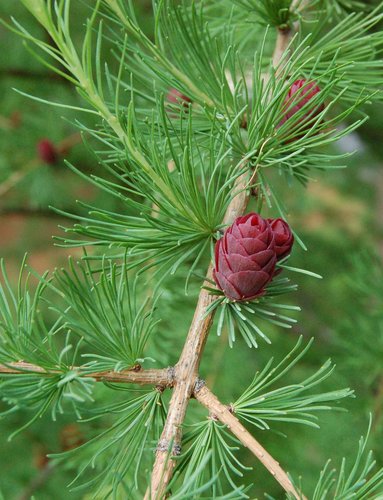
tamarack
Larix laricina
A rare deciduous conifer that defies the rules of winter, the Tamarack transforms from a soft green spire into a pillar of liquid gold every autumn. It is the hardy sentinel of northern wetlands and a favorite haunt for porcupines and rare forest birds.
Quick Identification
Size
Typically 10–20 meters (33–66 feet) tall with a trunk diameter of 30–60 cm (12–24 inches).
Colors
Bright blue-green needles in spring and summer, turning brilliant golden-yellow in autumn; bark is tight and gray when young, becoming reddish-brown and scaly with age.
Key Features
- Deciduous needles that turn gold and drop in autumn
- Needles grow in brush-like clusters of 10-20 on short woody spurs
- Small, egg-shaped cones that stand upright on the branches
- Symmetrical, pyramidal shape in younger trees
- Thrives in wet, boggy soils where other trees struggle
When You’ll See Them
Behavior
The Tamarack is a fascinating anomaly in the world of conifers: it is deciduous. While it produces cones and needles like a pine or spruce, it sheds its foliage every autumn after a spectacular display of golden color. This unique cycle allows it to survive in incredibly cold, harsh northern climates where the weight of snow on year-round needles might break other trees. In the spring, it is one of the first trees to show life, sprouting soft, feathery needles that are remarkably tender to the touch.
Ecologically, the Tamarack plays a vital role as a pioneer species, often being the first tree to colonize open bogs or burnt-over areas. Because it is highly intolerant of shade, it thrives in open, sunny locations and will eventually be replaced by more shade-tolerant species like Black Spruce as a forest matures. For humans, the wood has historically been prized for its rot-resistance, used by indigenous peoples for snowshoe frames and by early settlers for ship knees and fence posts.
EverydayEarth exclusive
Camera Tips
When targeting a Tamarack with your trail camera, you aren't just filming a tree—you are documenting a seasonal transformation. To capture the 'Great Gold Transition,' set your camera to time-lapse mode rather than just motion trigger. A single shot every 6 to 12 hours from late September through mid-November will create a stunning visual record of the needles shifting from green to brilliant gold to bare branches. Position the camera at a wide angle to capture the entire silhouette of the tree against the sky to emphasize its pyramidal form.
Tamaracks are magnets for specific wildlife that you can capture using motion triggers. Porcupines love to feed on the inner bark (cambium) and tender twigs, often climbing high into the canopy. If you notice stripped bark on upper branches, point your camera toward the trunk at a height of 5-7 feet to catch these climbers in action. Similarly, the Spruce Grouse is frequently found near Tamaracks, feeding on the needles; low-angle placement near the base of the tree is best for these ground-dwelling birds.
Pay close attention to lighting and camera settings. The Tamarack's golden hue can sometimes 'blow out' or appear overexposed in bright midday sun. If your camera allows for exposure adjustment, slightly underexposing during the peak color weeks can help retain the rich amber tones. For the best color saturation, ensure the sun is behind the camera (front-lighting the tree). During the winter, the bare, 'dead-looking' branches of the Tamarack provide a high-contrast backdrop that is excellent for spotting wintering birds or squirrels that would otherwise be hidden by dense evergreen foliage.
Similar Species
Species that look similar or are commonly confused with tamarack.
European Larch
Has much larger cones (2-4 cm) and drooping secondary branchlets, whereas Tamarack cones are tiny (under 2 cm) and branches are more horizontal.
Western Larch
Grows much taller (up to 50m) and is found in the Pacific Northwest; its cones have distinct 'whiskers' or bracts that stick out between scales.
Black Spruce
Often grows in the same bogs, but it keeps its short, stiff needles year-round and has a much darker, denser appearance.
Frequently Asked Questions
Record tamarack at your habitat
Connect a camera to start building your own species record — AI identifies every visitor automatically.