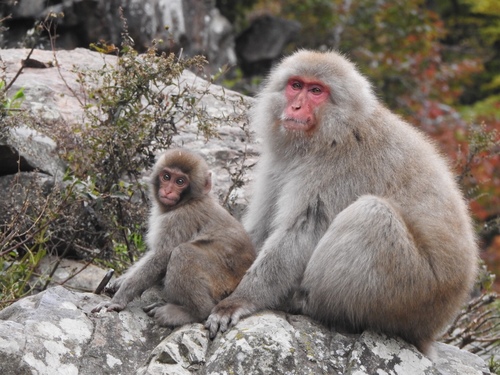
Japanese Macaque
Macaca fuscata
Meet the world's most cold-hardy primate, the Japanese Macaque. Famous for their love of hot springs and complex social lives, these intelligent 'Snow Monkeys' bring a touch of wild wisdom to any trail camera gallery.
Quick Identification
Size
Body length of 47–60 cm (18–24 in); weight ranges from 8–11 kg (17.6–24.2 lbs) for females and 11–18 kg (24.2–39.7 lbs) for males.
Colors
Thick brownish-grey or sandy-brown fur with a distinctively bright pink or reddish hairless face and rump; underparts are usually lighter cream or grey.
Key Features
- Bright pinkish-red hairless face and rump
- Thick, woolly coat adapted for sub-zero temperatures
- Short, stumpy tail typically under 10 cm (4 in)
- Robust, stocky build with powerful limbs
When You’ll See Them
Geographic range
Where Does the Japanese Macaque Live?
The Japanese Macaque is uniquely native to the Japanese archipelago, claiming the title of the world's northernmost-living non-human primate. Their core range spans three of Japan's four main islands—Honshu, Shikoku, and Kyushu—where they thrive in environments ranging from subtropical lowlands to the frigid, snow-covered northern peaks. While they are primarily forest-dwellers, their range increasingly overlaps with human development, making them a common sight in rural and suburban areas across Japan.
Basemap © OpenStreetMap contributors
Behavior
Japanese Macaques are highly social primates that live in complex matrilineal troops, often numbering between 20 and 100 individuals. These groups are organized around a strict social hierarchy where rank is frequently inherited from the mother. They are famous for their high intelligence and 'cultural' behaviors, such as the well-documented practice of washing sweet potatoes in salt water or bathing in volcanic hot springs to stay warm during the winter. They spend a large portion of their day foraging on the ground or grooming one another, a behavior that reinforces social bonds and reduces troop tension.
As the most cold-adapted non-human primates, they exhibit remarkable resilience. In the winter, they slow their activity to conserve energy, huddling together for warmth. In areas where they live close to humans, they can be remarkably bold and clever. They are known to inhabit the 'satoyama'—the traditional Japanese borderland between mountains and villages—where they may raid crops or gardens, demonstrating an ability to adapt their foraging strategies to take advantage of human-provided resources.
EverydayEarth exclusive
Camera Tips
To capture the best footage of Japanese Macaques, you should position your camera at their eye level—typically about 2 to 3 feet (60–90 cm) off the ground. Since they are primarily terrestrial when moving between foraging sites, mounting the camera on a tree trunk facing a well-worn trail or a forest clearing will yield excellent full-body shots. If you are monitoring a backyard or garden, aim the camera toward low stone walls or fence lines, which macaques often use as highways to avoid moving through tall grass or dense brush.
Macaques are highly intelligent and notoriously curious. They are likely to investigate any new object in their environment, so we strongly recommend using a 'bear box' or a heavy-duty security lockbox for your camera. Without protection, a curious troop member might tilt the lens, chew on the housing, or even try to pull the camera off the tree. Using a 'no-glow' or black LED infrared flash is also advisable; while they are diurnal, the invisible flash prevents the monkeys from being distracted or spooked by the device during low-light hours in the early morning.
Because macaques travel in large social groups, video mode is far superior to still photos for this species. Set your camera to record 20-30 second clips with a short trigger interval. This allows you to capture the fascinating social dynamics of the troop, such as juveniles playing, mothers carrying infants, or adults engaging in social grooming. In terms of timing, they are strictly diurnal, so focus your efforts on daylight hours. If you are filming in the winter, ensure you have high-quality lithium batteries, as the 'Snow Monkey' lives up to its name and standard alkaline batteries will fail quickly in the freezing temperatures where these primates thrive.
Similar Species
Species that look similar or are commonly confused with Japanese Macaque.
Frequently Asked Questions
Record Japanese Macaque at your habitat
Connect a camera to start building your own species record — AI identifies every visitor automatically.