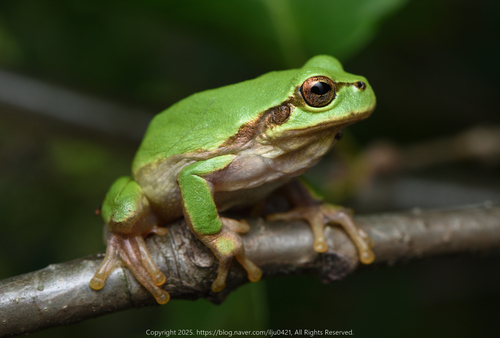
Japanese Tree Frog
Dryophytes japonicus
The Japanese Tree Frog is a master of camouflage and a legendary survivor of the cold. These charismatic climbers bring the night to life with their rhythmic calls and acrobatic hunting style.
Quick Identification
Size
3-4.5 cm (1.2-1.8 inches) in length; typically weighs 2-5 grams
Colors
Back ranges from vibrant lime green to mottled gray or brown depending on the environment; belly is white or cream. Both sexes feature a prominent dark brown or black stripe from the snout to the shoulder.
Key Features
- Enlarged suction-cup toe pads for vertical climbing
- Dark horizontal stripe running through the eye
- Smooth skin with rapid color-changing ability
- Small, slender body with a rounded snout
When You’ll See Them
Behavior
Japanese Tree Frogs are agile climbers known for their remarkable ability to navigate vertical surfaces, including trees, shrubs, and even the glass of suburban windows. They are famously vocal, particularly during high humidity; their rhythmic 'rain call' is often heard before a storm begins, acting as a natural barometer for local residents. While they are solitary hunters for most of the year, they are highly social during the breeding season when males form loud choruses near water sources.
These amphibians are exceptionally hardy, possessing a unique physiological ability to survive extreme cold by producing high concentrations of glucose and glycerol in their blood, which acts as a natural antifreeze. In backyard settings, they are relatively bold and will often take up residence near porch lights to take advantage of the insects attracted to the glow. They are largely harmless to humans and serve as excellent indicators of a healthy local ecosystem.
EverydayEarth exclusive
Camera Tips
To capture high-quality footage of a Japanese Tree Frog, focus your camera efforts on vertical surfaces near artificial light sources. These frogs are 'smart' hunters and will often sit directly on or next to porch lights or windows to catch moths and flies. Position your camera about 1 to 2 feet away from a wall or a broad-leafed plant where you have heard them calling. Because they are quite small, using a camera with a macro focus capability or a close-up lens attachment is essential for getting clear, sharp details of their skin texture and golden eyes.
Since these frogs are cold-blooded and small, standard Passive Infrared (PIR) sensors may struggle to detect their heat signature. To combat this, set your camera's sensitivity to 'High' or use a time-lapse mode that triggers every 30 to 60 seconds during their peak hours. If your camera has a 'fast trigger' setting, enable it; these frogs can move surprisingly fast when they lung at prey. Mounting the camera at chest height (3 to 5 feet) is usually more effective than ground placement, as they spend very little time on the floor.
Night vision is crucial, but many IR flashes can be too powerful at close range, 'blowing out' the image and turning the frog into a white blob. If your camera allows, turn down the flash intensity. If not, placing a piece of semi-opaque tape over part of the flash can soften the light. For the best action shots, wait for a rainy or humid night in early summer; this is when they are most active and likely to display their vocal sac inflation while calling, which makes for spectacular video content.
Similar Species
Species that look similar or are commonly confused with Japanese Tree Frog.
Frequently Asked Questions
Record Japanese Tree Frog at your habitat
Connect a camera to start building your own species record — AI identifies every visitor automatically.