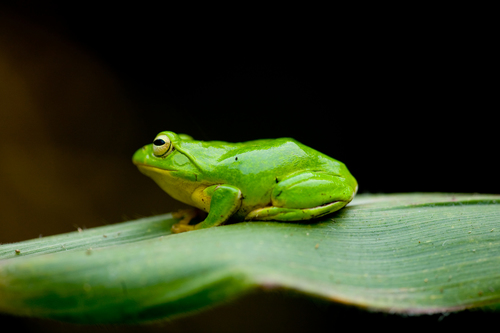
Schlegel's Green Tree Frog
Zhangixalus schlegelii
An emerald jewel of the Japanese countryside, Schlegel's Green Tree Frog is a master of camouflage known for its melodic nighttime serenades and fascinating foam nests.
Quick Identification
Size
3–5.5 cm (1.2–2.2 inches) in length; females are significantly larger than males.
Colors
Vibrant emerald green upper body, occasionally with fine dark spotting; creamy white to pale yellow belly; golden-yellow irises.
Key Features
- Uniform bright green skin without a black eye stripe
- Golden-yellow irises with horizontal pupils
- Large, circular adhesive toe pads for climbing
- Pointed snout and slender body profile
When You’ll See Them
Behavior
Schlegel's Green Tree Frog is a secretive, arboreal species known for its remarkable camouflage and unique breeding habits. Unlike many other tree frogs that lay eggs directly in water, this species is famous for its 'underground' approach. During the spring, males descend from the trees to dig small burrows in the muddy banks of ponds or rice paddies. From these hidden chambers, they produce a rhythmic, melodic chirping to attract females.
Once a pair meets, they create a foam nest within the burrow—a white, meringue-like mass that protects the eggs from predators and dehydration. When the eggs hatch and heavy rains arrive, the foam liquefies, allowing the tadpoles to wash out of the burrow and into the nearby water. Outside of the breeding season, these frogs are quiet and solitary, spending their nights hunting high in the vegetation and their days resting perfectly still on the surface of leaves.
EverydayEarth exclusive
Camera Tips
To capture the Schlegel's Green Tree Frog, timing is everything. Focus your efforts during the peak breeding season from April to June, especially on humid or rainy nights. Because these frogs are small and blend in perfectly with green leaves, you will need to place your camera much closer to the ground or specific vegetation than you would for a mammal. Use a mounting stake to position your camera about 1 to 2 feet off the ground, aiming it at the muddy banks of a garden pond or the broad leaves of hostas and hydrangeas.
Lighting is a critical factor for nocturnal amphibian photography. While most trail cameras use infrared (IR) light which results in black-and-white images, Schlegel's Green Tree Frog is best appreciated in full color. If your camera supports it, use a low-intensity white light flash or an external, motion-activated garden light to trigger a color recording. If using IR, look for 'No-Glow' models to avoid startling the frog, as they can be sensitive to sudden changes in light while calling.
The most dramatic footage often comes from the males' vocalizations. Set your camera to 'Video Mode' with a high sensitivity setting and a short trigger delay. Place the camera near a suspected calling site—look for small holes in the mud near the water's edge. If you hear the 'kiri-kiri' call, that is where you should point your lens. Because these frogs are small, a camera with a short focal distance (macro capability) will yield the best results; otherwise, ensure the camera is at least 3 feet away to stay within the lens's focus range.
For a unique perspective, try a 'top-down' mount over overhanging branches near water. These frogs often climb high to feed after the breeding season ends. Avoiding the use of chemical pesticides in your garden will not only help these frogs survive but will also increase your chances of capturing them on camera, as it ensures a steady supply of the insects they prey upon.
Similar Species
Species that look similar or are commonly confused with Schlegel's Green Tree Frog.
Frequently Asked Questions
Record Schlegel's Green Tree Frog at your habitat
Connect a camera to start building your own species record — AI identifies every visitor automatically.