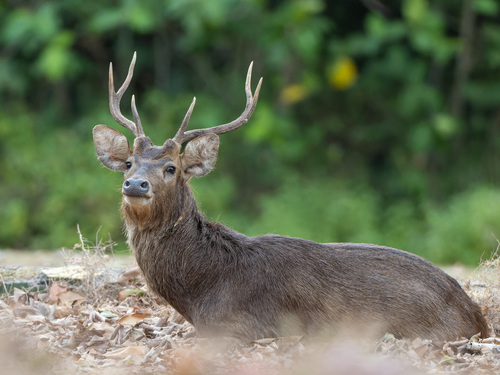
Javan Rusa
Rusa timorensis
The Javan Rusa is a rugged and adaptable deer known for its coarse, shaggy coat and striking three-tined antlers. Originally from the islands of Indonesia, this alert mammal has become a fascinating sight in backyards and wild spaces across the Southern Hemisphere.
Quick Identification
Size
Shoulder height of 80–110 cm (31–43 in); weights range from 50–115 kg (110–250 lbs) for females and up to 160 kg (350 lbs) for large males.
Colors
Uniformly greyish-brown to woody-brown coat with a coarse texture; males are typically darker than females and develop a slight mane on the neck.
Key Features
- Three-tined antlers on males with the inner top tine being the longest
- Large, rounded ears that appear slightly oversized
- Coarse, shaggy coat without the spots seen in other deer species
- Pale cream-colored fur on the underbelly and inner thighs
When You’ll See Them
Geographic range
Where Does the Javan Rusa Live?
The Javan Rusa is native to the tropical islands of Indonesia and Timor-Leste, with its primary ancestral strongholds on the islands of Java and Bali. Because of its popularity as a game animal, it has been widely introduced across the Southern Hemisphere, establishing significant wild populations in Australia, New Zealand, Papua New Guinea, and several Indian Ocean islands like Mauritius. It is a highly successful colonizer that thrives in a variety of climates, from tropical wetlands to temperate forests.
Basemap © OpenStreetMap contributors
Behavior
These deer are primarily crepuscular, meaning they are most active during the twilight hours of dawn and dusk. In areas where they feel safe or have become accustomed to human activity, they may extend their foraging into the daylight hours, though they generally spend the heat of the day resting in shaded thickets. During the breeding season, or rut, males become significantly more vocal and aggressive, frequently wallowing in mud to scent-mark their territory and engaging in antler wrestling to establish dominance.
EverydayEarth exclusive
Camera Tips
Lighting is your biggest challenge with this species because of their crepuscular nature. Use a camera with a fast trigger speed (under 0.5 seconds) and a high-quality infrared flash to avoid blurry 'ghost' images during their peak activity times at dawn and dusk. Setting your camera to 'Burst Mode' is highly recommended, as it allows you to capture the subtle social interactions between herd members that a single shot might miss.
If you are trying to attract them to a specific spot for a photo, they are often drawn to salt licks or water sources during dry spells. In suburban environments, they are frequent visitors to fruit trees or vegetable patches. However, keep in mind that they are extremely scent-sensitive. When checking your camera or changing batteries, try to wear rubber boots and avoid touching nearby vegetation with your bare hands, as human scent can cause a herd to avoid the area for several days.
Similar Species
Species that look similar or are commonly confused with Javan Rusa.
Frequently Asked Questions
Record Javan Rusa at your habitat
Connect a camera to start building your own species record — AI identifies every visitor automatically.