Jeffrey pine
Pinus jeffreyi
Known for its sweet, vanilla-scented bark and massive 'gentle' cones, the Jeffrey pine is a majestic icon of the high Sierras. It thrives where other trees falter, providing a vital sanctuary for mountain-dwelling wildlife.
Quick Identification
Size
Height: 25–40 m (80–130 ft), occasionally reaching 60 m; Trunk diameter: 0.6–1.2 m (2–4 ft)
Colors
Needles are blue-green to gray-green; bark is deeply furrowed and ranges from purple-brown to cinnamon-red
Key Features
- Needles in bundles of three, 5–10 inches long
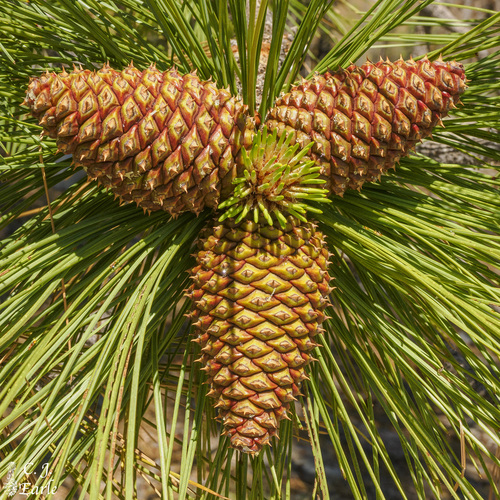
- Large, woody cones 5–11 inches long with inward-pointing prickles ('Gentle Jeffrey')
- Bark smells like vanilla, butterscotch, or pineapple when sniffed in the crevices
- Thick, plate-like bark with deep, dark fissures
When You’ll See Them
Behavior
The Jeffrey pine is a slow-growing, long-lived conifer that acts as a foundational species in high-altitude ecosystems. Unlike many other pines, it is highly tolerant of serpentine soils—soils rich in heavy metals that are toxic to most other plants. This allows the Jeffrey pine to dominate harsh, rocky ridges where it stands as a rugged sentinel against the wind and snow.
Though stationary, the tree is a hub of animal activity. It has evolved a symbiotic relationship with local wildlife; its heavy, winged seeds are a primary food source for squirrels and birds, who in turn help disperse the seeds. The tree's thick bark is a marvel of adaptation, providing significant insulation against the low-intensity ground fires that are common in its native western range.
EverydayEarth exclusive
Camera Tips
When using an AI-powered camera to capture the Jeffrey pine, your primary goal is to document the rich 'wildlife hotel' the tree provides. Mount your camera directly to the trunk using a strap at about 5 to 7 feet high, pointing it downward along a sturdy horizontal branch. This is a highway for Douglas squirrels and chipmunks. These animals frequently use specific branches as 'husking stations' where they strip the scales off Jeffrey pine cones to reach the seeds. If you see a pile of cone debris (a midden) at the base of the tree, that is the perfect spot for a ground-level camera.
To capture the iconic bark texture, place your camera about 3 to 4 feet away from the trunk on a tripod. Use a side-lighting angle—ideally during the early morning or late afternoon golden hours. This creates long shadows in the deep furrows of the bark, highlighting the 'jigsaw puzzle' plate patterns that distinguish it from the Ponderosa pine. Avoid using a flash at night, as it tends to wash out the subtle cinnamon and purple hues of the bark.
If your camera is equipped with a wide-angle lens, position it low to the ground and tilt it upward toward the canopy. This 'worm's-eye view' captures the massive scale of the tree and the way the blue-green needles contrast against the sky. During the late summer and fall, keep an eye on the heavy cones. If you can safely position a camera near a cluster of maturing cones, you are likely to capture incredible footage of Clark's Nutcrackers, which use their specialized bills to pry out the high-protein seeds.
Similar Species
Species that look similar or are commonly confused with Jeffrey pine.
Frequently Asked Questions
Record Jeffrey pine at your habitat
Connect a camera to start building your own species record — AI identifies every visitor automatically.