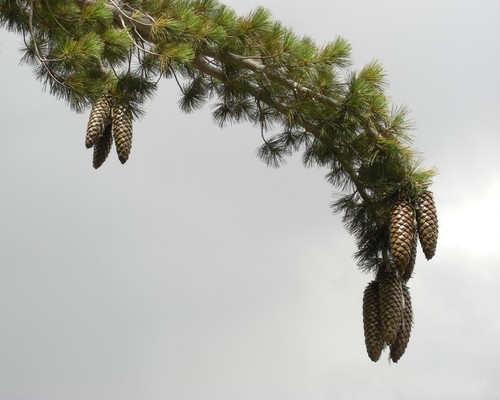
sugar pine
Pinus lambertiana
Meet the undisputed King of Pines. With the largest cones in the world and a height that rivals skyscrapers, the sugar pine is a titan of the American West.
Quick Identification
Size
Height: 40–60 meters (130–200 ft), reaching up to 82 meters (270 ft); Trunk diameter: 1.5–2.5 meters (5–8 ft).
Colors
Needles are blue-green to silvery; mature bark is gray-brown to cinnamon-red; cones start green and turn light brown.
Key Features
- Massive woody cones measuring 10–20 inches long
- Needles bundled in groups of five (5-needle pine)
- Deeply furrowed bark with a reddish-cinnamon inner color
- Distinctive horizontal branches that droop at the tips
When You’ll See Them
Behavior
Known as the 'King of Pines,' the sugar pine is the tallest and most massive of all pine species. It grows with a distinctive architecture, featuring a straight, towering trunk and horizontal branches that extend like arms, often weighed down at the ends by its famously large cones. Unlike many smaller pines, it is a slow-growing, long-lived species that can survive for over 500 years, becoming a dominant anchor of the mountain forest canopy.
The sugar pine plays a vital role in its ecosystem, acting as a high-rise apartment complex for forest wildlife. Its name comes from the sweet, sugary resin that seeps from its wounds, which was historically prized by Native American tribes. It doesn't 'behave' in the animal sense, but it responds dynamically to the environment, shedding its massive cones in late summer and fall to distribute seeds that feed a wide variety of birds and small mammals.
EverydayEarth exclusive
Camera Tips
Capturing the majesty of a sugar pine requires a different approach than fast-moving wildlife. Because of their immense height, place your camera at a low angle and tilt it upward to capture the towering trunk and the unique 'arm-like' branching pattern against the sky. If you are using an AI-powered camera like the ones we recommend, set it to a wide-angle mode to fit as much of the silhouette as possible. To capture the famous cones, look for a 'mother tree' with low-hanging branches or find a clearing where you can get a clear line of sight into the mid-canopy during the golden hour; the backlighting will make the silver-blue needles glow.
For those interested in the wildlife that the sugar pine attracts, place your camera near the base of the tree or on a nearby stump. Large sugar pine cones are a magnet for Douglas squirrels and Clark’s nutcrackers. Set your trigger speed to high and use a 'burst' mode; these animals are incredibly fast when they are harvesting seeds from the massive cone scales. You don't need artificial bait—the fallen cones themselves are the ultimate natural lure for everything from chipmunks to black bears who may investigate the tree for insects or sap.
If you have a permanent backyard or trail setup, consider a long-term time-lapse. The way a sugar pine handles the seasons is spectacular. Set your camera to take one photo a day from the same vantage point to watch the massive cones develop from small green nubs in the spring to 20-inch giants in the fall, followed by the dramatic accumulation of snow on its horizontal limbs during winter. Ensure your camera is mounted to a secondary post rather than the pine itself if you want to avoid 'camera shake' from the wind catching the tree's massive canopy.
Similar Species
Species that look similar or are commonly confused with sugar pine.
Frequently Asked Questions
Record sugar pine at your habitat
Connect a camera to start building your own species record — AI identifies every visitor automatically.