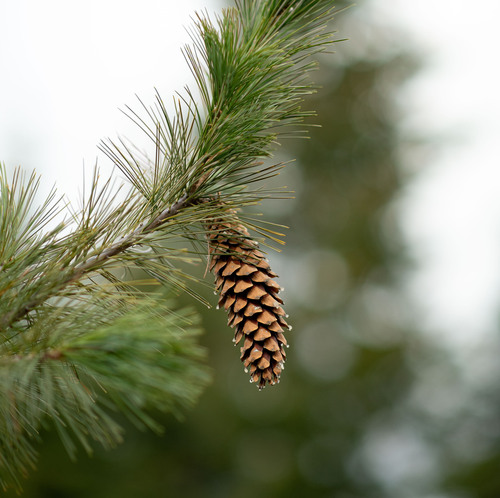
western white pine
Pinus monticola
The western white pine, Idaho’s state tree, is a silver-toned giant that defines the rugged forests of the Northwest. With its long, curved cones and soft bundles of five needles, it is a favorite for both wildlife and backyard foresters.
Quick Identification
Size
Typically 100–160 ft (30–50 m) tall with a trunk diameter of 2–5 ft (0.6–1.5 m); record specimens exceed 200 ft.
Colors
Blue-green needles with silvery-white stomatal lines; grayish-brown bark that matures into dark rectangular plates; light brown woody cones.
Key Features
- Needles strictly in bundles of five
- Long, slender, slightly curved cones 5-12 inches in length
- Smooth, silvery-gray bark on young trees maturing into square plates
- Tall, straight trunk with horizontal branches in regular tiers
When You’ll See Them
Behavior
The western white pine is a majestic conifer known for its rapid vertical growth and its historical significance as a 'monarch' of the Pacific Northwest forests. Unlike many other pines, it is relatively shade-tolerant when young but eventually reaches for the canopy to dominate the forest skyline. It plays a vital role in the ecosystem by providing structural complexity to the forest and serving as a massive carbon sink.
This tree is famously susceptible to white pine blister rust, a fungal disease that decimated populations in the 20th century. However, resilient survivors and modern replanting efforts are helping the species make a comeback in backyard forests and wildlands alike. Its interactions with humans are largely aesthetic and conservation-oriented today, though its wood remains highly prized for its fine grain and workability.
EverydayEarth exclusive
Camera Tips
Capturing the western white pine on camera requires a different strategy than mobile wildlife. To showcase the tree's distinctive 'silver' needles, position your camera to take advantage of 'backlighting.' When the sun is behind the tree in the early morning or late afternoon, the white stomatal lines on the needles will glow, making the tree stand out from darker forest backgrounds. Use a wide-angle lens if you want to capture the tree's impressive vertical scale, or place the camera at a distance of at least 30 feet to get the full profile in the frame.
If you are using an AI-powered camera to monitor visitors, the western white pine is a hub of activity. Mount your camera directly onto the trunk about 5-7 feet up, facing a sturdy horizontal branch. This is the 'highway' for Douglas squirrels and various nuthatches. If you can safely reach the higher canopy, placing a camera near a cluster of maturing cones in late summer is a surefire way to capture Clark's Nutcrackers, which are the primary seed dispersers for this species. No bait is needed; the high-fat seeds are the natural lure.
For those interested in the tree's lifecycle, set your camera to time-lapse mode during the spring (May-June). You can document the 'bud break' and the rapid expansion of new, lime-green growth. Ensure your camera is securely strapped to a post or neighboring tree to prevent wind-sway from ruining the time-lapse alignment. In winter, the dark gray plates of the bark create a high-contrast background that makes snow-dusted branches look stunning, so consider increasing your exposure slightly to prevent the camera's sensor from underexposing the dark bark against the bright snow.
Similar Species
Species that look similar or are commonly confused with western white pine.
Sugar Pine
Sugar pines have much longer cones (up to 20 inches) and the needles have a more twisted appearance.
Limber Pine
Limber pines have shorter cones and much more flexible branches that can often be tied in a knot without breaking.
Whitebark Pine
Found at much higher elevations; its cones are shorter, rounder, and remain closed until broken open by birds.
Frequently Asked Questions
Record western white pine at your habitat
Connect a camera to start building your own species record — AI identifies every visitor automatically.