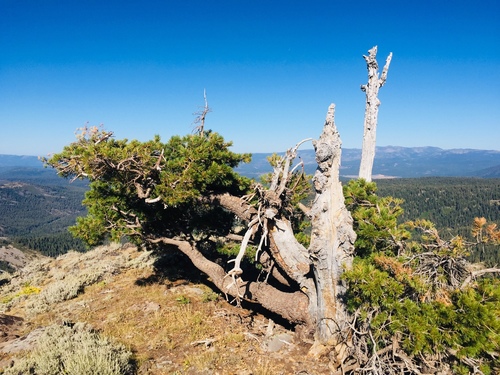
Whitebark Pine
Pinus albicaulis
The stoic sentinel of the high peaks, the Whitebark Pine is a hardy conifer that thrives where other trees fail. Known for its silvery bark and its symbiotic bond with mountain birds, it is a vital lifeline for subalpine wildlife.
Quick Identification
Size
Typically 5–20 meters (16–66 feet) tall; trunk diameter up to 1.5 meters (5 feet).
Colors
Silvery-white to light gray bark on young trees; dark green needles in bundles of five; deep purple to brown cones.
Key Features
- Needles grow in bundles (fascicles) of five
- Egg-shaped cones that do not open on their own
- Smooth, silvery-white bark on younger branches and stems
- Stunted, twisted growth form (krummholz) at high elevations
When You’ll See Them
Behavior
The Whitebark Pine is a high-altitude specialist, often acting as the pioneer species that colonizes harsh, wind-swept ridges where few other plants can survive. It functions as a keystone species in subalpine ecosystems, providing a vital source of high-fat, high-protein seeds that sustain a wide variety of wildlife. Unlike many other pines, its cones stay closed and do not drop their seeds naturally; the tree relies almost entirely on Clark's Nutcrackers to pry the cones open and cache the seeds in the ground, which facilitates new growth.
These trees are remarkably slow-growing and long-lived, with some specimens surviving for over 1,000 years. In the face of intense mountain winds, they often take on a 'krummholz' form—a German word for 'crooked wood'—where they grow stunted and shrub-like against the rocks. In more sheltered areas, they maintain a more traditional upright, multi-stemmed appearance.
EverydayEarth exclusive
Camera Tips
Capturing the majesty of a Whitebark Pine requires a camera setup that can handle the elements. Because these trees live at high altitudes, ensure your camera housing is weather-sealed and your batteries are rated for cold temperatures. Lithiums are preferred over alkaline to prevent power drops during freezing mountain nights. Mount your camera on a sturdy, older branch or a nearby rock using a heavy-duty swivel mount; the high winds at the timberline can cause significant blur if the camera isn't rock-solid.
To capture the 'wildlife' aspect of this tree, aim your lens at the ripening cones in late summer (August through September). This is when Clark’s Nutcrackers and squirrels are most active. A trigger speed of 0.2 seconds or faster is essential to catch the quick movements of birds landing on the branch tips. If you are lucky enough to have a Whitebark Pine in a backyard bordering a wilderness area, set your camera at a medium height—about 5 feet—to capture the birds working the upper canopy while still keeping the dramatic bark texture in view.
Time-lapse mode is a secret weapon for this species. Set your camera to take one photo every 30 minutes during daylight hours. Over a season, this will beautifully document the melting snow, the emergence of the purple cones, and the eventual harvest by local wildlife. For the best lighting, position your camera facing North or South to avoid the direct 'lens flare' of the high-altitude sun while capturing the long, dramatic shadows that define the rugged subalpine landscape.
Similar Species
Species that look similar or are commonly confused with Whitebark Pine.
Limber Pine
Limber Pine cones open to release seeds and have scales with thickened tips, whereas Whitebark cones stay closed until broken by birds.
Lodgepole Pine
Lodgepole Pines have needles in bundles of two, while Whitebark Pine needles always grow in bundles of five.
Western White Pine
Western White Pines have much longer, banana-shaped cones and generally grow at lower, more forested elevations.
Frequently Asked Questions
Record Whitebark Pine at your habitat
Connect a camera to start building your own species record — AI identifies every visitor automatically.