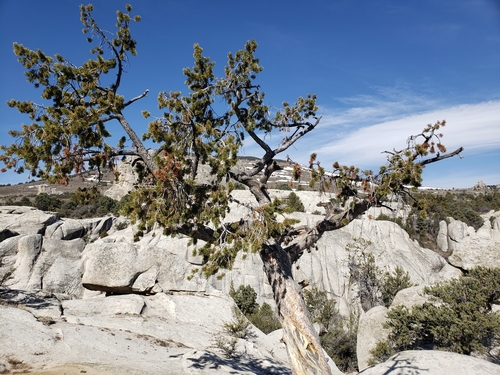
limber pine
Pinus flexilis
The limber pine is an ancient sentinel of the high peaks, known for its incredible flexibility and centuries-long lifespan. A vital food source for mountain wildlife, it transforms harsh rocky ridges into thriving subalpine ecosystems.
Quick Identification
Size
Height: 12-20 meters (40-65 feet); Trunk diameter: 60-90 cm (24-35 inches). Can be much smaller/stunted at timberline.
Colors
Light gray, smooth bark on young trees; dark brown/gray furrowed bark on old trees; bluish-green needles.
Key Features
- Needles in bundles of five
- Extremely flexible branches that can be tied in knots without breaking
- Large, thick-scaled woody cones (3-6 inches long)
- Stunted or 'krummholz' growth forms at high elevations
- Lacks wings on its seeds
When You’ll See Them
Behavior
In the high-altitude landscape, these trees act as ecosystem anchors. They grow incredibly slowly, with some individuals living for over 2,000 years. Their flexible branches allow them to withstand heavy snow loads and intense mountain winds that would snap more rigid species. To humans and wildlife alike, they offer a sense of ancient resilience, often twisting into beautiful, gnarled shapes in response to the harsh elements.
EverydayEarth exclusive
Camera Tips
Since limber pines often grow on windy ridges, ensure your camera mount is exceptionally secure. A heavy-duty strap or a screw-in mount is better than a simple bungee cord to prevent 'false triggers' caused by the tree swaying in the wind. If you are mounting the camera to the tree itself, place it about 5-6 feet up the trunk, facing a nearby branch or an adjacent tree where birds might land before approaching the cones. Position the camera facing North or South to avoid the harsh glare of the high-altitude sun, which can blow out the light gray bark in photos.
For those interested in the long game, the limber pine is an excellent subject for a long-term timelapse. Because they are evergreen and grow in dramatic environments, a year-long project can capture the transition from deep winter snows to the vibrant growth of 'candles' (new needle shoots) in the spring. If you're looking for animal life, setting your camera to 'Burst Mode' is essential; the nutcrackers and chipmunks that frequent these trees move with lightning speed when raiding the cones.
Lastly, consider the 'sap factor.' Limber pines are very resinous. When placing a camera near active cones or on the trunk, be careful not to get sticky sap on the lens or PIR sensor. Using a small protective housing or a lens hood can save you a difficult cleaning job later.
Similar Species
Species that look similar or are commonly confused with limber pine.
Frequently Asked Questions
Record limber pine at your habitat
Connect a camera to start building your own species record — AI identifies every visitor automatically.