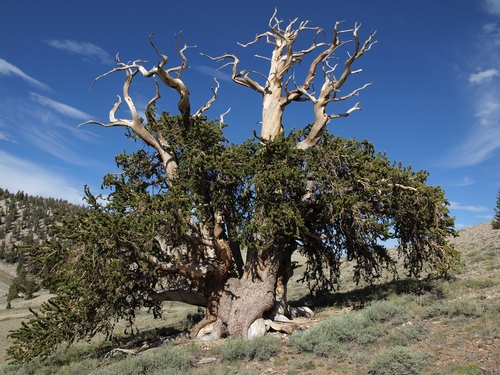
Great Basin bristlecone pine
Pinus longaeva
The oldest living non-clonal organisms on the planet, these 'living fossils' have stood guard over the high deserts for over 5,000 years. Their twisted, sun-bleached forms tell a story of endurance that spans the rise and fall of entire civilizations.
Quick Identification
Size
Typically 5–15 meters (16–50 feet) tall with a trunk diameter of 2.5–3.6 meters (8–12 feet).
Colors
Needles are a deep, waxy green with white resin flecks; bark is bright orange-yellow to cinnamon-brown, weathering to a silver-grey on dead wood.
Key Features
- Needles in bundles of five, tightly packed like a bottle brush
- Cones feature distinct curved prickles (bristles) on each scale
- Extremely dense, gnarled wood often stripped of bark on one side
- Flecked with white resin spots on the needles
When You’ll See Them
Behavior
The Great Basin bristlecone pine is a master of patience and survival, defined by its incredible longevity. Unlike most species, these trees grow in some of the harshest conditions on Earth—high altitudes with thin air, biting winds, and nutrient-poor soil. Their 'behavior' is characterized by extremely slow growth, sometimes adding less than an inch of girth per century. This slow pace results in wood that is so dense and resinous that it is virtually impervious to rot, insects, and fungi.
One of their most fascinating survival strategies is 'sectorial dieback.' When a portion of the tree is damaged or the root system is compromised, only the specific strip of bark and wood connected to that root dies, while the rest of the tree continues to thrive. This leads to the iconic appearance of ancient bristlecones: a single living branch supported by a thin ribbon of bark on an otherwise skeletal, wind-sculpted trunk. They do not compete with other plants; instead, they occupy the barren limestone and dolomite slopes where other species simply cannot survive.
EverydayEarth exclusive
Camera Tips
Capturing the Great Basin bristlecone pine on camera requires a shift from traditional motion-triggering to interval or time-lapse photography. Because these trees are stationary, AI cameras should be set to capture images at set intervals—perhaps once an hour or during specific 'golden hour' windows. This allows you to witness the dramatic interplay of light and shadow across the twisted, orange-hued wood, which is often more visually interesting than the green needles themselves.
For the most striking results, position your camera at a low angle looking upward. This emphasizes the gnarled, ancient stature of the tree against the deep blue of the high-altitude sky. If your camera supports long exposures, the bristlecone pine is arguably the best subject for astrophotography. Its skeletal forms create hauntingly beautiful silhouettes against the Milky Way. Ensure your camera is mounted on a heavy, stable tripod or a fixed mount, as the high-altitude winds where these trees live can be powerful enough to cause significant blur in your shots.
When focusing on details for species identification, use a macro setting or place the camera within two feet of a low-hanging branch. Look for the 'bottle-brush' needle pattern and the tiny, white resin dots that characterize Pinus longaeva. These resin flecks are a key diagnostic feature for AI identification models. During the late summer, try to capture the young cones; they are a deep reddish-purple and provide a vibrant color contrast to the muted greys and oranges of the ancient wood.
Because these trees are often found in wilderness areas with extreme temperatures, ensure your camera has high-quality, cold-resistant batteries (lithium is preferred over alkaline). In the winter, the accumulation of rime ice on the needles can make for spectacular photos, but you will need to protect the lens with a hood to prevent snow buildup from obscuring the view. Avoid using traditional baits or lures, as these are plants, but consider the positioning of the sun; a north-facing camera will provide more consistent lighting throughout the day without the lens flare of a direct southern exposure.
Similar Species
Species that look similar or are commonly confused with Great Basin bristlecone pine.
Rocky Mountain bristlecone pine
Features much heavier white resin flecks on the needles, looking like white dandruff, and is found further east in Colorado and New Mexico.
Foxtail pine
Lacks the sharp 'bristles' on its cones and has a more rounded, less gnarled crown compared to the ancient bristlecone.
Limber pine
Has larger, thicker-scaled cones without prickles and more flexible branches that can be tied in knots without breaking.
Frequently Asked Questions
Record Great Basin bristlecone pine at your habitat
Connect a camera to start building your own species record — AI identifies every visitor automatically.