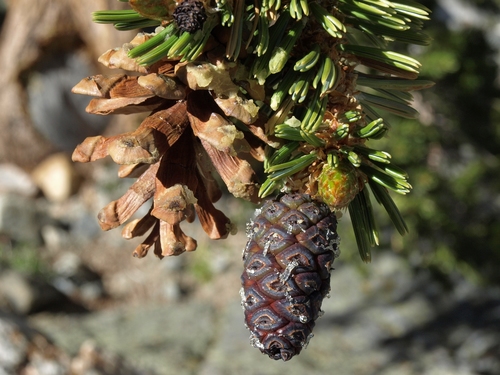
foxtail pine
Pinus balfouriana
A resilient relic of the ice age, the foxtail pine is an ancient sentinel found only on California's highest peaks. With its distinctive bottle-brush branches and orange-plated bark, it is one of the most striking and long-lived conifers in the world.
Quick Identification
Size
Height: 10–22 meters (33–72 feet); Trunk diameter: up to 2 meters (6.6 feet).
Colors
Deep green to blue-green needles; bark is bright cinnamon-orange to grayish-brown with deep, square-shaped plates.
Key Features
- Dense needles arranged in tight, cylindrical 'foxtail' plumes
- Five needles per bundle (fascicle)
- Cinnamon-orange bark that forms thick, protective plates
- Ovoid, dark purple-to-brown cones with minimal prickles
When You’ll See Them
Behavior
The foxtail pine is a slow-growing, long-lived survivor of California's most rugged high-elevation environments. Unlike many shorter-lived trees, these pines can reach ages exceeding 2,000 years, standing as stoic witnesses to centuries of climate shifts. They grow with a characteristic upright, often multi-stemmed form in their youth, but as they age, they take on the gnarled, weathered appearance typical of subalpine conifers, with many ancient specimens exhibiting 'strip-bark' growth where only a small ribbon of living tissue remains to support the canopy.
As a foundational species in its ecosystem, the foxtail pine plays a vital role in soil stabilization and water retention on granite slopes. While it doesn't 'move' in the animal sense, it is highly reactive to its environment; its needles are retained for up to 20 or 30 years to maximize nutrient efficiency in low-resource settings. It shares a fascinating symbiotic relationship with mountain birds, particularly the Clark's Nutcracker, which helps disperse its seeds across the high-altitude landscape.
EverydayEarth exclusive
Camera Tips
When photographing a foxtail pine with a wildlife or trail camera, the 'subject' isn't just the tree itself, but the vibrant ecosystem that lives within its branches. To capture the best images, position your camera at a slight upward angle at the base of a mature specimen or on a nearby rock outcrop. This highlights the tree's iconic 'foxtail' needle structure and the rich, cinnamon-orange texture of the bark, which glows spectacularly during the 'golden hour' shortly before sunset. If your camera has a time-lapse mode, use it to capture the way these trees endure high-altitude storms or the slow movement of shadows across their gnarled trunks.
Since these trees are hubs for mountain wildlife, aim your sensors at the middle branches or the base of the trunk. You are likely to capture visitors like the Clark's Nutcracker, Douglas squirrels, or even the rare Sierra Nevada red fox that uses these high-elevation groves for cover. If you are placing a camera in a backyard cabin setting, ensure the lens is shaded from the harsh high-altitude sun to avoid lens flare, and consider a wide-angle lens setting to capture the full silhouette of the tree against the alpine sky.
Winter offers a unique opportunity for stunning imagery, but it requires cold-weather preparation. Ensure your camera is equipped with lithium batteries, which perform better in the freezing temperatures of the Sierra or Klamath ranges. High-resolution photos of snow-loaded 'foxtail' branches can be breathtaking, but be mindful of placement; heavy snowpack can bury cameras placed too low to the ground. Aim for a height of 5-6 feet on a sturdy trunk to keep the camera clear of the rising snowline throughout the season.
Similar Species
Species that look similar or are commonly confused with foxtail pine.
Great Basin Bristlecone Pine
The bristlecone has distinct long, curved bristles on its cone scales, which the foxtail pine lacks.
Whitebark Pine
Whitebark pines have cones that stay closed and disintegrate to release seeds, whereas foxtail pine cones open naturally.
Limber Pine
Limber pine needles are less densely packed and do not form the tight 'foxtail' cylinder characteristic of P. balfouriana.
Frequently Asked Questions
Record foxtail pine at your habitat
Connect a camera to start building your own species record — AI identifies every visitor automatically.