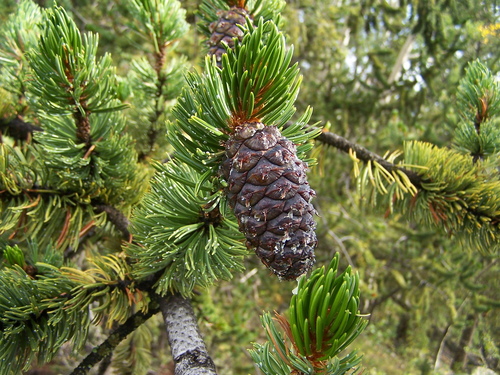
Rocky Mountain bristlecone pine
Pinus aristata
Meet the ancient sentinels of the Rockies. The Rocky Mountain bristlecone pine is a living relic of deep time, twisting its gnarled branches against the harshest winds for thousands of years.
Quick Identification
Size
Typically 8–15 meters (25–50 feet) in height with a trunk diameter of 1–1.5 meters (3–5 feet).
Colors
Needles are a deep, waxy green; bark varies from grey-brown to a vibrant cinnamon-red on weathered sections; distinctive white resin flecks on needles.
Key Features
- Needles in bundles of 5 with prominent white resin spots
- Short, dense needle clusters giving branches a 'bottle-brush' look
- Gnarled, twisted trunk growth in older specimens
- Cones are 6–11 cm long with a very sharp, fragile bristle on each scale
When You’ll See Them
Behavior
The Rocky Mountain bristlecone pine is a master of slow-motion survival. It grows with incredible patience, sometimes adding only a few centimeters to its height over several decades. This slow growth results in extremely dense, resinous wood that is highly resistant to rot, insects, and fungi. In the harshest conditions at the tree line, these trees often exhibit 'dieback' or 'strip-bark' growth, where only a narrow vein of living tissue connects the roots to a few green branches, while the rest of the tree appears as beautifully sculpted, dead wood.
While they are solitary and do not 'socialize' in the animal sense, they form the backbone of high-altitude ecosystems. They provide critical shelter for subalpine wildlife and have a unique relationship with the Clark's nutcracker, which helps disperse their seeds. Humans have long revered these trees as living icons of the American West; some individual specimens in Colorado are confirmed to be over 2,500 years old, making them some of the oldest living organisms on the planet.
EverydayEarth exclusive
Camera Tips
Because the Rocky Mountain bristlecone pine is a stationary subject, the traditional motion-trigger setting on your trail camera won't be very effective unless you are hoping to catch a passing bird. Instead, use the 'Time Lapse' or 'Field Scan' mode. Setting the camera to take a photo every 4 to 6 hours will allow you to create a stunning visual record of the tree as it battles the changing seasons. This is particularly effective in high-altitude environments where snow patterns and dramatic cloud movements can be captured over several months.
When mounting your camera, keep in mind that these trees are often found on steep, windswept slopes. Avoid mounting the camera directly to a thin branch of the bristlecone itself, as the intense mountain winds will cause significant motion blur. Instead, secure your camera to a nearby rock outcrop or a sturdier, younger tree using a swivel mount. Aim the lens to capture the lower half of the trunk and the ground around it; this allows you to showcase the unique, gnarled grain of the wood while also catching any high-altitude wildlife like pikas or Clark’s nutcrackers that frequent the tree.
Lighting is your best friend when photographing the Pinus aristata. The orange and cinnamon hues of the weathered bark are most vibrant during the 'golden hours'—just after sunrise and before sunset. If your camera allows for scheduled operation, prioritize these times. In the winter, the harsh glare from snow can wash out the details of the dark green needles. To combat this, try to position the camera facing north or south to avoid direct midday sun hitting the lens, which ensures the white resin flecks on the needles remain visible in your shots.
Lastly, consider the 'hybrid' mode if your camera supports it. This will take scheduled time-lapse photos but also trigger a short video if an animal moves within the frame. Bristlecone pines are vital habitat for high-elevation species; capturing a mountain goat seeking shelter under its ancient boughs adds a layer of storytelling to your footage. Ensure your SD card is high-capacity and your batteries are lithium-based, as alkaline batteries fail quickly in the freezing temperatures where these pines thrive.
Similar Species
Species that look similar or are commonly confused with Rocky Mountain bristlecone pine.
Great Basin Bristlecone Pine
Found further west in Nevada and California, it lacks the white resin flecks found on the needles of the Rocky Mountain species.
Limber Pine
Occupies similar altitudes but has smoother needles without resin spots and much larger, thicker-scaled cones without bristles.
Foxtail Pine
Found in California; its needles are more rounded and it lacks the distinctive resin 'dandruff' of the Rocky Mountain bristlecone.
Frequently Asked Questions
Record Rocky Mountain bristlecone pine at your habitat
Connect a camera to start building your own species record — AI identifies every visitor automatically.