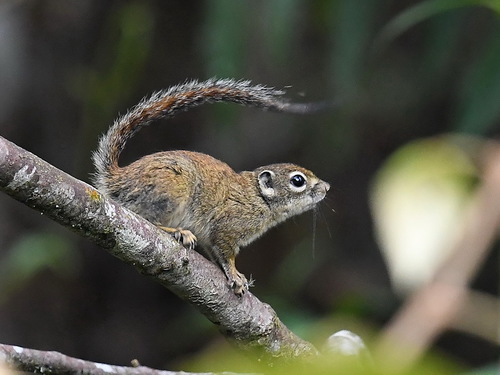
Jentink's Squirrel
Sundasciurus jentinki
A high-altitude specialist endemic to the mountains of Borneo, Jentink's Squirrel is a master of the misty canopy. Identifiable by its delicate eye-rings and olive-toned fur, this elusive rodent is a highlight for any montane explorer.
Quick Identification
Size
Head and body 12–14 cm (4.7–5.5 in); tail 11–13 cm (4.3–5.1 in); weight approx 55–80g (1.9–2.8 oz)
Colors
Speckled olive-brown upperparts, creamy-buff or pale grey underparts, light rings around eyes
Key Features
- Distinctive pale eye-rings
- Speckled olive-brown fur
- Small, slender arboreal build
- Found exclusively in high-altitude montane forests
When You’ll See Them
Geographic range
Where Does the Jentink's Squirrel Live?
This squirrel is a true specialist of Southeast Asia, found exclusively on the island of Borneo. Its range is restricted to the high-altitude mountain spines of the island, primarily within the Malaysian states of Sabah and Sarawak and the northern parts of Indonesian Kalimantan. It is most frequently encountered on the slopes of iconic peaks like Mount Kinabalu and the Crocker Range.
Basemap © OpenStreetMap contributors
Behavior
Jentink's Squirrel is a shy, primarily arboreal rodent that thrives in the misty canopies of Borneo's mountain ranges. Unlike many of its bolder lowland cousins, this species is relatively quiet and moves with a characteristic series of quick, jerky dashes interspersed with periods of frozen alertness. They are most active during the daylight hours, particularly in the early morning when they forage through the middle and upper layers of the forest.
Socially, Jentink's Squirrels are usually observed alone or in pairs. They are highly specialized for life in cooler, high-altitude climates and are rarely seen near human settlements unless those settlements directly border primary montane forest. They communicate through high-pitched chirps and tail flicking, especially when a potential predator like a bird of prey or a civet is detected nearby.
EverydayEarth exclusive
Camera Tips
Capturing the Jentink's Squirrel on a trail camera requires a specialized approach due to their arboreal nature and high-altitude habitat. Instead of placing your camera on the ground, look for horizontal branches or 'sky bridges' between 2 and 5 meters high. These squirrels often use the same moss-covered branches as regular transit routes through the canopy. Use a heavy-duty strap or a specialized tree mount to ensure the camera is stable against mountain winds.
Trigger speed is your most important setting. These squirrels are fast and small; a trigger speed of 0.2 seconds or faster is ideal to prevent capturing just a blurry tail. If your camera supports it, use a 'burst' or 'multi-shot' mode to increase the chances of getting a clear profile view. Since the montane forest is often shrouded in mist or cloud cover, ensure your camera has high-quality IR LEDs for low-light situations, though daytime color photos are the goal.
To lure a Jentink's Squirrel into the frame, a small amount of local fruit or a nut-based paste can be applied to a branch directly in front of the lens. However, avoid changing their natural diet significantly. Position the camera so it faces away from the rising or setting sun to avoid lens flare, which is particularly sharp at higher elevations. Because of the high humidity and constant mist in their habitat, always include a fresh desiccant pack inside the camera's battery compartment to prevent internal fogging.
Similar Species
Species that look similar or are commonly confused with Jentink's Squirrel.
Frequently Asked Questions
Record Jentink's Squirrel at your habitat
Connect a camera to start building your own species record — AI identifies every visitor automatically.