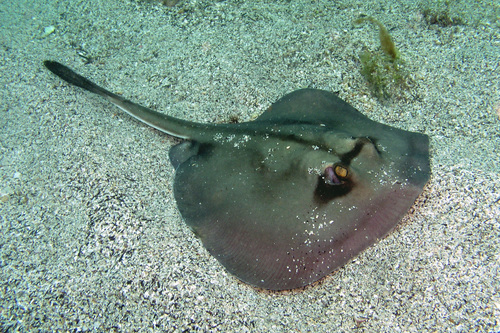
Kapala Stingaree
Urolophus kapalensis
An elusive master of camouflage endemic to Australia's eastern shores, the Kapala Stingaree is a stunning example of reef biodiversity. With its unique bell-shaped nose and diamond disc, it glides silently through the inshore waters of Queensland and New South Wales.
Quick Identification
Size
Total length up to 51 cm (20 in); disc width typically 20-30 cm (8-12 in)
Colors
Dull greenish to brownish-grey above with highly variable dark markings between the eyes and over the back; creamy white or pale underside
Key Features
- Rounded diamond-shaped pectoral fin disc
- Distinctive bell-shaped curtain of skin between nostrils
- Slender tail featuring a small dorsal fin and leaf-shaped caudal fin
- Variable dark pattern usually concentrated around the eyes
When You’ll See Them
Geographic range
Where Does the Kapala Stingaree Live?
Where Does the Kapala Stingaree Live? This stingray is a proud Australian endemic, found nowhere else on Earth except for the temperate and subtropical waters of the southwestern Pacific. Its range is highly localized, stretching from the sunny coastlines of southeastern Queensland down through the coastal waters of New South Wales. It thrives in the productive inshore zone, rarely venturing far from the continental shelf and preferring the stable environments of rocky reef systems.
Basemap © OpenStreetMap contributors
Behavior
The Kapala Stingaree is a bottom-dwelling species that spends much of its time resting on the sea floor or partially buried in soft sediment. By using its pectoral fins to stir up sand, it creates a shallow depression to camouflage itself from predators like larger sharks. While generally solitary, they are frequently found in high densities around rocky reef fringes where food is abundant.
Despite their somewhat sluggish appearance, these stingarees are capable of quick bursts of speed when threatened. They possess a venomous stinging spine on the tail used strictly for self-defense. In areas with high human activity, such as coastal swimming beaches or fishing piers, they tend to be skittish and will move away if they detect heavy vibrations in the water.
EverydayEarth exclusive
Camera Tips
Capturing the Kapala Stingaree requires specialized underwater equipment, as they are strictly marine. If you live near a coastal canal or have access to a private jetty in New South Wales or Southern Queensland, you can deploy a waterproof action camera (like a GoPro) inside a weighted housing. Position the camera on a sandy patch immediately adjacent to rock walls or kelp forests, as these rays travel along the 'edge' habitats to forage.
To increase your chances of a sighting, use a scent-based lure. A small mesh bag filled with crushed oily fish, like pilchards or mullet, secured about one meter in front of the lens will often draw them in. Because they forage by scent, they will spend significant time investigating the bait, giving your AI camera plenty of time to trigger and record. Ensure your camera is set to a wide-angle view, as these rays often hover just inches above the substrate.
Lighting is the biggest challenge for underwater captures. If your 'backyard' water is deeper than 5 meters, you will lose the red spectrum of light, making the ray look overly blue or grey. Use a diffused underwater video light with a high CRI (Color Rendering Index) to reveal the true greenish hues and dark markings on the ray's back. Early morning sets provide the most natural light, but late afternoon is when the rays are most active and likely to pass by your station.
Similar Species
Species that look similar or are commonly confused with Kapala Stingaree.
Frequently Asked Questions
Record Kapala Stingaree at your habitat
Connect a camera to start building your own species record — AI identifies every visitor automatically.