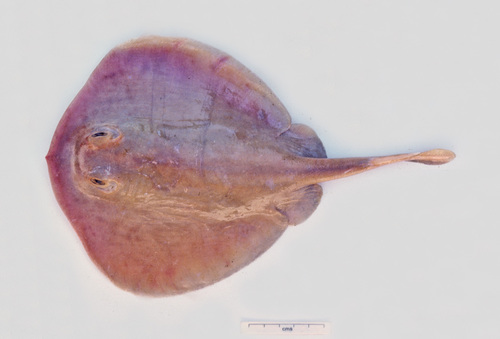
Yellowback Stingaree
Urolophus sufflavus
A golden-hued gem of the deep, the Yellowback Stingaree is a master of camouflage on Australia's continental shelf. Rarely seen by casual observers, this elusive ray is a prize find for underwater camera enthusiasts.
Quick Identification
Size
Total length up to 42 cm (16.5 inches); disc width typically ranges between 25-30 cm (10-12 inches).
Colors
Uniform yellowish-brown to sandy golden dorsal surface; underside is starkly contrasting white or pale cream with darker disc margins.
Key Features
- Oval or diamond-shaped pectoral fin disc
- Short, thick tail ending in a small caudal fin
- Prominent venomous stinging spine located mid-tail
- Lack of distinct spots or ornate patterns on the back
When You’ll See Them
Behavior
The Yellowback Stingaree is a bottom-dwelling specialist that spends much of its life masterfully camouflaged against the seafloor. Like many members of the Urolophidae family, it utilizes a 'settling' behavior where it uses its pectoral fins to disturb the sand or silt, allowing the sediment to fall back over its body. This leaves only the eyes and spiracles (breathing holes) exposed, making it nearly invisible to both predators like larger sharks and unsuspecting prey.
While largely solitary, these stingarees are known for their docile nature, only using their venomous tail spine as a last resort when stepped on or handled. Because they inhabit the deeper waters of the continental shelf, their social interactions are poorly understood, but they appear to be non-territorial, moving across the soft substrate in search of high concentrations of benthic invertebrates. In the presence of underwater cameras, they often display a 'hovering' curiosity if attracted by scent.
EverydayEarth exclusive
Camera Tips
Capturing the Yellowback Stingaree requires moving beyond the backyard and into the 'blue backyard' of the New South Wales coast. Because this species lives at significant depths (typically over 100 meters), standard trail cameras won't work. You will need a dedicated Baited Remote Underwater Video (BRUV) system or a high-pressure underwater housing rated for at least 150 meters. For the best results, deploy your camera on flat, silty plains near the edge of the continental shelf, as these 'underwater deserts' are the primary foraging grounds for the Yellowback.
Scent is the most powerful tool for attracting this species. Use a perforated bait canister attached to a long arm in front of the lens. Fill the canister with oily mashed fish, such as sardines or mackerel, or crushed local prawns. The scent plume will travel with the bottom currents, drawing the stingarees toward your camera from down-current. Position the camera at a low angle, roughly 20-30 centimeters off the substrate, to capture the ray's unique undulating swimming motion and the golden-yellow hue of its dorsal side.
Lighting is a critical factor at these depths where sunlight is filtered and dim. Yellowback Stingarees have sensitive eyes adapted for low light; using bright white LED strobes can cause them to flee. Instead, utilize red-filtered lights, which are less detectable to many marine species and allow for more natural foraging behavior. Set your camera to a high bit-rate and at least 30-60 frames per second. This is essential for distinguishing the Yellowback from its cousins, as the specific way the wing margins ripple is a key diagnostic feature for experts reviewing the footage.
Similar Species
Species that look similar or are commonly confused with Yellowback Stingaree.
Common Stingaree
Found in much shallower coastal waters and has a darker, more brownish-grey coloration compared to the Yellowback's golden hue.
Kapala Stingaree
Features a more angular disc shape and is generally found in even deeper waters, often with subtle dark markings that the Yellowback lacks.
Frequently Asked Questions
Record Yellowback Stingaree at your habitat
Connect a camera to start building your own species record — AI identifies every visitor automatically.