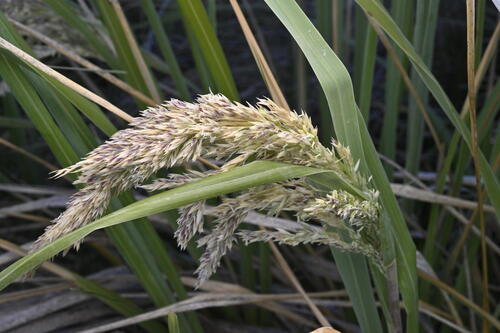
Karetu
Anthoxanthum redolens
Known as the 'Holy Grass' of the Southern Hemisphere, Karetu fills the air with a stunning vanilla scent. Its lush, arching blades create a fragrant sanctuary that attracts a hidden world of lizards and songbirds to your backyard.
Quick Identification
Size
Leaves 15–60 cm (6–24 in) long; flowering stalks reach up to 1 m (3.3 ft)
Colors
Bright emerald green blades; flower heads emerge greenish-purple and mature to a golden straw color
Key Features
- Strong vanilla or sweet hay fragrance when crushed
- Wide, flat, arching leaf blades
- Large, dense, shimmering flower panicles
- Clump-forming perennial growth habit
When You’ll See Them
Behavior
Karetu, often called 'Holy Grass,' is a perennial grass known primarily for its sensory presence. Unlike many wild grasses that go unnoticed, Karetu makes itself known through a potent, sweet aroma caused by high levels of coumarin. In the wild, it acts as a foundational member of the ecosystem, growing in lush, swaying clumps that provide essential architectural structure to the landscape.
While it doesn't move of its own volition, it is a highly reactive plant. It bows gracefully in high winds and its scent becomes particularly heavy in the air following rain or when the sun warms its blades. Traditionally, it has a deep cultural relationship with humans; Māori people used the fragrant leaves for weaving, scenting oils, and as bedding, making it a plant that is as much a part of human history as it is the natural world.
EverydayEarth exclusive
Camera Tips
Capturing Karetu on an AI-powered camera requires a shift from tracking movement to capturing growth and ecological interactions. To see the plant truly 'in action,' use a time-lapse setting. Set your camera to take a frame every 15 to 30 minutes during the late spring. When played back, you will see the 'shooting' of the flower stalks—a rapid growth spurt where the golden heads rise above the green foliage in a matter of days. Ensure your camera is mounted on a very stable post, as even slight vibrations from the wind can make a plant time-lapse look shaky.
Because Karetu provides excellent cover, it is a high-traffic zone for ground-dwelling wildlife. Place your camera at a very low 'skink-eye' level (about 4-6 inches off the ground) aimed at a gap in the grass clumps. This is the best way to catch footage of lizards, large insects, or ground-foraging birds that use the grass for protection. During the summer seeding months, adjust your camera to a higher angle (2-3 feet) to focus on the flower heads. Small birds like finches and silvereyes frequently land on these stalks to feed on the seeds, offering fantastic opportunities for close-up avian photography.
Lighting is your best tool for making Karetu look spectacular. Position your camera facing toward the sunrise or sunset (east or west) so that the grass is 'backlit.' This causes the fine hairs on the leaves and the translucent husks of the seeds to glow, creating a halo effect that AI sensors can track with high contrast. If your camera has a motion-trigger sensitivity setting, turn it down slightly or use 'Zone Detection' to avoid getting hundreds of clips of the grass simply blowing in the wind, unless you are specifically looking to capture the hypnotic 'wave' effect of a breezy day.
Similar Species
Species that look similar or are commonly confused with Karetu.
Frequently Asked Questions
Record Karetu at your habitat
Connect a camera to start building your own species record — AI identifies every visitor automatically.