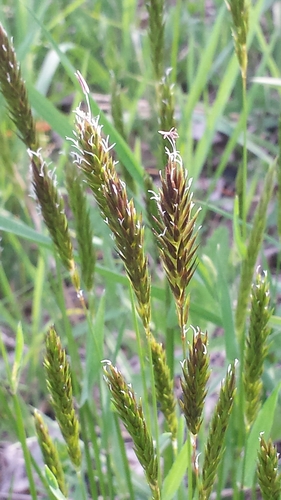
sweet vernal grass
Anthoxanthum odoratum
One of the first signs of spring, sweet vernal grass fills the air with the nostalgic scent of vanilla and freshly cut hay. Its golden spikes are a hallmark of ancient meadows and a beautiful addition to any wildlife-friendly backyard.
Quick Identification
Size
20-50 cm (8-20 inches) in height; flower spikes 2-5 cm (0.8-2 inches) long
Colors
Bright green leaves; flower heads start green and mature to a golden-yellow or bronze hue
Key Features
- Distinctive sweet vanilla or hay scent when crushed or dried
- Compact, spike-like flower head that appears early in spring
- Short, hairy leaf sheaths especially at the junction of the blade
- Golden-bronze color at maturity
When You’ll See Them
Behavior
Sweet vernal grass is a short-lived perennial grass known primarily for its rapid growth in the early spring. Unlike many other meadow grasses that wait for the heat of summer, this species is often one of the first to send up its flowering stalks, providing a vital early-season structure to grasslands. It is a clump-forming species that spreads through wind-dispersed seeds, often colonizing acidic or nutrient-poor soils where more competitive grasses struggle to take hold.
The plant is most famous for its chemical profile; it contains coumarin, a compound that gives the grass its signature scent of newly mown hay or vanilla. This fragrance is particularly potent when the grass is crushed, dried, or cut. In a backyard setting, it acts as a hardy ground cover that supports local biodiversity, offering shelter for ground-dwelling insects and early-season forage for pollinators that visit its wind-pollinated flowers.
EverydayEarth exclusive
Camera Tips
Documenting sweet vernal grass with a trail camera requires a shift from motion-tracking to time-lapse photography. Because plants don't trigger PIR (Passive Infrared) sensors, you should set your camera to 'Time Lapse' mode with an interval of one photo every 1-4 hours. This allows you to create a stunning visual record of the grass's transition from bright green spring shoots to its iconic golden-bronze seed heads. To get the best results, mount your camera on a short stake just 12 inches off the ground, angling it slightly upward to capture the seed heads against the sky.
Lighting is the most critical factor for capturing the delicate textures of this grass. Position your camera to face the sunrise or sunset (East or West). This 'backlighting' will catch the fine, silver-white hairs on the leaf sheaths and make the translucent flower spikes appear to glow with a golden halo. If your camera allows for manual exposure settings, slightly underexposing the shot can help preserve the detail in the golden flower heads and prevent them from looking 'blown out' in direct sunlight.
To capture the 'hidden' life around the grass, place your camera near a large, established clump of sweet vernal grass during the morning hours. Small mammals like voles often use the dense base of these clumps for cover, and early-season butterflies may perch on the stalks to warm themselves. Use a high-resolution video setting (1080p or 4K) to record the grass swaying in the wind; the fluid movement is a hallmark of a healthy vernal meadow. If your camera has a macro lens or a close-focus feature, try to get within 2 feet to capture the intricate structure of the panicles before they fully open.
Similar Species
Species that look similar or are commonly confused with sweet vernal grass.
Frequently Asked Questions
Record sweet vernal grass at your habitat
Connect a camera to start building your own species record — AI identifies every visitor automatically.