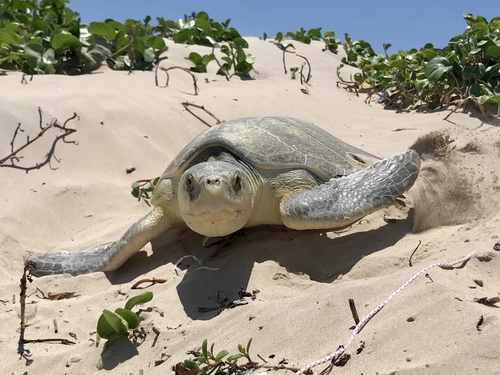
Kemp's Ridley Sea Turtle
Lepidochelys kempii
Meet the rarest and most endangered sea turtle on the planet. Small in size but massive in spirit, the Kemp's ridley is the only sea turtle that nests in massive daytime waves called arribadas.
Quick Identification
Size
Carapace length 58-70 cm (23-28 inches); Weight 35-45 kg (75-100 lbs)
Colors
Olive-green to greyish-green carapace; creamy-white or pale yellow plastron (underside); black hatchlings
Key Features
- Heart-shaped carapace nearly as wide as it is long
- Five pairs of costal scutes on the shell
- World's smallest sea turtle species
- Hooked, parrot-like beak
- Triangular-shaped head
When You’ll See Them
Geographic range
Where Does the Kemp's Ridley Sea Turtle Live?
Kemp’s ridley sea turtles are primarily residents of the North American continent, centered heavily within the warm waters of the Gulf of Mexico. Their most critical nesting grounds are found along the beaches of Rancho Nuevo in Tamaulipas, Mexico, with secondary nesting sites scattered along the Texas coast. While the Gulf is their core home, juveniles are known to venture out into the Atlantic Ocean, migrating up the Eastern Seaboard as far north as New England and occasionally Nova Scotia.
Basemap © OpenStreetMap contributors
Behavior
Kemp’s ridley sea turtles are unique among their kin for their 'arribada' nesting behavior—a Spanish word meaning 'arrival.' During these events, hundreds or even thousands of females converge on a single beach to lay eggs simultaneously. Unlike most sea turtles that nest under the cover of darkness to avoid predators, Kemp's ridleys are primarily diurnal nesters, often appearing on beaches during the heat of the day.
In the water, these turtles are solitary and spend much of their time in shallow coastal waters foraging along the muddy or sandy bottom. While they are powerful swimmers capable of long migrations, they are highly susceptible to cold-stunning if they linger too long in northern waters during the winter. They are generally shy and avoid human interaction, though they frequently inhabit areas with high boat traffic or commercial fishing activity.
EverydayEarth exclusive
Camera Tips
For those lucky enough to live on a Gulf Coast or Atlantic beachfront, capturing a Kemp's ridley requires patience and strict adherence to local laws. Place your camera on a low-profile tripod or stake, roughly 12-18 inches off the sand, facing the tide line. Aim for a wide-angle view to capture the turtle's track—a unique, asymmetrical crawl pattern that is a tell-tale sign of this species. Since they are one of the few sea turtles to nest during the day, standard daytime settings will work well, but ensure your camera has a fast trigger speed to catch them as they move between the surf and the dunes.
Lighting is the most critical factor for camera safety. If you are monitoring at night, never use white light or standard flashes, as these disorient both nesting mothers and emerging hatchlings, leading them away from the ocean. Use a camera with high-quality 'no-glow' Infrared (IR) LEDs that operate in the 940nm spectrum. This allows you to see the turtles without them seeing the light, ensuring their natural behavior remains undisturbed and they reach the water safely.
Environmental protection is vital when deploying gear in salt-heavy environments. Use a dedicated marine housing or a high-quality weather-shield to protect your camera from corrosive salt spray and blowing sand. If you are using an AI-powered camera with motion detection, set the sensitivity to 'High' but mask out the moving surf in your detection zones to avoid thousands of false triggers from the waves. Check your local ordinances before placement, as many sea turtle nesting beaches have strict regulations regarding equipment on the sand during the summer months.
Similar Species
Species that look similar or are commonly confused with Kemp's Ridley Sea Turtle.
Frequently Asked Questions
Record Kemp's Ridley Sea Turtle at your habitat
Connect a camera to start building your own species record — AI identifies every visitor automatically.