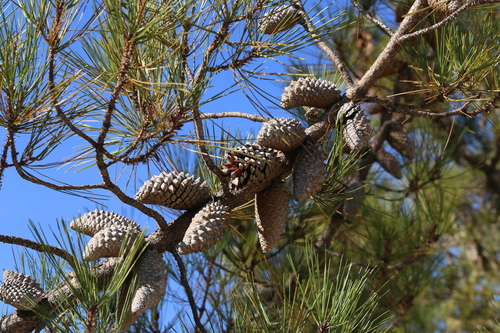
knobcone pine
Pinus attenuata
The Knobcone Pine is the rugged survivalist of the tree world, holding its seeds in 'time capsules' that only fire can open. Its twisted form and unique knobby cones make it a striking silhouette against the rocky slopes of the American West.
Quick Identification
Size
Typically 8–24 meters (26–79 feet) tall with a trunk diameter of 0.3–0.9 meters (1–3 feet).
Colors
Needles are a distinctive pale yellow-green; bark is dark gray-brown and flaky; cones are light brown and weathered gray.
Key Features
- Cones remain closed and attached to branches for decades (serotinous)
- Needles grow in bundles of three, 3–7 inches long
- Asymmetric cones with prominent 'knobs' on the outer scales
- Often features multiple trunks or a skewed, hardy growth form
When You’ll See Them
Behavior
The Knobcone Pine is a fascinating example of botanical resilience, often described as a 'fire-dependent' species. Unlike many other pines that release their seeds annually, the Knobcone Pine produces serotinous cones that are sealed shut with a thick resin. These cones can remain on the tree for 30 to 50 years, sometimes even becoming embedded in the wood as the tree grows around them. The seeds are only released when the heat of a wildfire melts the resin, allowing the tree to aggressively re-colonize scorched earth where other plants struggle.
In terms of social ecology, the Knobcone Pine is a 'pioneer species.' It is relatively short-lived for a conifer, often reaching maturity and dying within 60 to 100 years. It thrives in 'serpentine' soils—habitats high in heavy metals that are toxic to most other plants. By growing where others cannot, it provides essential cover and nesting sites for mountainous wildlife in otherwise barren landscapes.
EverydayEarth exclusive
Camera Tips
When targeting a Knobcone Pine with an AI camera like those featured on EverydayEarth, your goal is to capture the tree’s unique 'behavior' over time or the wildlife it attracts. Because the tree is stationary, time-lapse mode is your best friend. Set your camera to take one or two photos a day at noon. Over several months, you can compile a stunning sequence showing the needles shifting with the seasons or the slow development of the distinctive knobby cones. This is particularly effective in the spring when new 'candles' (fresh growth) emerge at the tips of the branches.
To capture wildlife interactions, focus your camera on the mid-section of the trunk or a cluster of cones. While the cones are sealed to humans, certain hardy squirrels and birds like the Clark's Nutcracker or the Western Scrub-Jay may investigate them. Place your camera 5–7 feet high on a neighboring tree, angled slightly downward to capture the activity on the Knobcone's branches. Use a high-sensitivity trigger setting, as the movement of a small bird against the backdrop of pine needles can be subtle.
Lighting is crucial for this species because of its pale, yellow-green color. Avoid placing the camera facing directly into the southern sun, which will wash out the needle detail. Instead, orient your camera toward the North or East. The 'Golden Hour' (shortly after sunrise or before sunset) provides the best side-lighting to emphasize the 'knobby' texture of the cones and the rugged, flaky texture of the bark, which makes for spectacular high-definition captures.
If you are in a region prone to temperature swings, keep an eye on your camera after a frost. The Knobcone Pine’s needles look particularly striking when dusted with ice or frost, providing a high-contrast image that stands out in a digital gallery. Because these trees grow in windy, exposed areas, ensure your camera mount is extra secure; wind-shake is the primary cause of false triggers and blurry images in pine forest environments.
Similar Species
Species that look similar or are commonly confused with knobcone pine.
Frequently Asked Questions
Record knobcone pine at your habitat
Connect a camera to start building your own species record — AI identifies every visitor automatically.