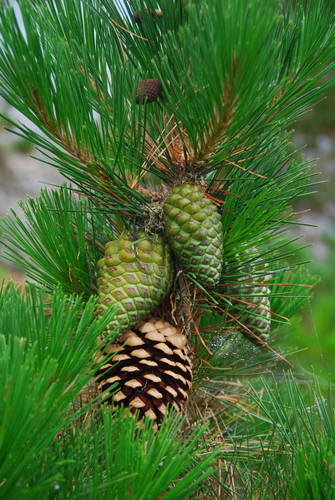
Monterey pine
Pinus radiata
The Monterey pine is a fast-growing coastal icon, known for its lush green needles and rugged bark. It serves as a majestic vertical forest, providing essential shelter and food for a diverse array of backyard birds and mammals.
Quick Identification
Size
Height of 15–30 m (50–100 ft) and a trunk diameter of 30–90 cm (12–36 in); can reach 60 m (200 ft) in ideal conditions.
Colors
Bright green to deep forest green needles; dark grey to reddish-brown bark with deep, rugged furrows.
Key Features
- Needles found in clusters of three
- Cones are noticeably lopsided or asymmetrical at the base
- Fast-growing habit with a dense, rounded crown
- Bark becomes deeply fissured and thick with age
When You’ll See Them
Behavior
The Monterey pine is a remarkable fast-grower, often reaching its full height in just a few decades. In its native coastal California habitat, it acts as a pioneer species, quickly colonizing open areas. It has a unique relationship with the coastal climate, often 'combing' moisture out of the morning fog, which then drips down to water its own root system and the plants below.
While it is a solitary giant in many backyard settings, in the wild it forms dense stands that provide a microclimate for various flora and fauna. These trees are highly social hubs for wildlife; their thick canopy offers a windbreak and nesting site for large birds like Red-tailed Hawks, while the deep crevices in their bark house an entire world of beneficial insects and spiders.
EverydayEarth exclusive
Camera Tips
Capturing the majesty of a Monterey pine requires a focus on both the grand scale and the minute details. For a great wide-angle shot of the entire tree, place your camera at a distance at least equal to the tree's height. Use a sturdy mount like a t-post rather than mounting to a nearby sapling, as the wind can cause significant motion blur in the foliage. Because these trees are evergreen, they provide a consistent backdrop for multi-year timelapses, which are perfect for showing the rapid growth this species is known for.
If you want to capture the wildlife that calls the tree home, focus your camera on the 'coning' branches. Use a high-quality AI-powered camera with a fast trigger speed to catch the frantic movement of squirrels or the quick visits of nuthatches and woodpeckers searching for seeds. Position the camera on a branch looking toward a cluster of cones, as this is where the most 'action' occurs. If the camera is placed high in the canopy, ensure it is securely strapped to a thick, stable limb to minimize sway during coastal gusts.
Lighting is your biggest challenge and your best friend with the Monterey pine. The deep green needles can appear almost black in harsh midday sun, creating high-contrast shadows that obscure detail. Aim to have your camera face North or South to avoid direct lens flare from the sun. The best images often happen during foggy mornings or late afternoons when the light hits the side of the trunk, highlighting the deep, craggy textures of the bark and the reddish hues within the furrows.
Finally, consider the seasonal changes in the tree's life cycle. While it stays green year-round, the male pollen cones appear in late winter or early spring, often coating the surrounding area in yellow dust. Setting your camera to capture high-resolution stills during this time can document the fascinating reproductive cycle. Always be mindful of sap; if you mount a camera directly to the trunk, use a small spacer to prevent sticky resin from sealing your camera mounting bracket or obscuring the lens.
Similar Species
Species that look similar or are commonly confused with Monterey pine.
Frequently Asked Questions
Record Monterey pine at your habitat
Connect a camera to start building your own species record — AI identifies every visitor automatically.