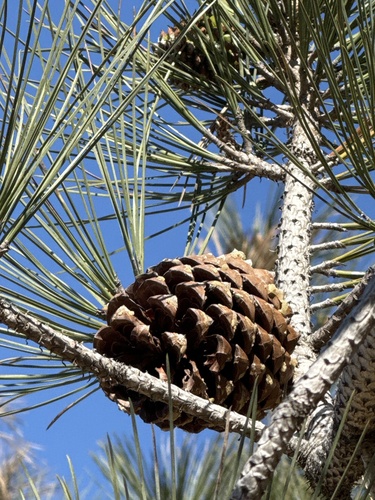
Torrey pine
Pinus torreyana
Meet the rarest pine in North America, a coastal survivor with a wind-sculpted silhouette and a secret connection to the California fog. Found only in two tiny pockets of the world, the Torrey pine is a living monument to botanical resilience.
Quick Identification
Size
Height 25–55 ft (8–17 m); trunk diameter up to 3 ft (1 m); needles 8–12 in (20–30 cm) long.
Colors
Gray-green to deep waxy green needles; gray-brown bark with deep reddish-brown furrows; dark chocolate-brown mature cones.
Key Features
- Needles in bundles of five
- Massive, heavy woody cones with thick scales
- Broad, open crown often sculpted by coastal winds
- Deeply fissured, thick bark on mature specimens
When You’ll See Them
Behavior
The Torrey pine is a resilient survivor of the California coast, known for its ability to thrive in nutrient-poor, sandy soils where other trees fail. Unlike many inland pines, it has adapted to the coastal environment by developing a deep taproot and a unique ability to capture moisture from the frequent Pacific fog. In its wild habitat, the tree's form is highly variable; near the ocean bluffs, it often grows in stunted, wind-pruned shapes, while trees planted in sheltered areas can grow tall and straight with a classic pyramidal crown.
Ecologically, the Torrey pine is a cornerstone of its habitat. It provides vital nesting sites for raptors and smaller birds, while its large, nutrient-rich seeds (pine nuts) are a primary food source for Western Scrub-Jays and squirrels. The relationship with the scrub-jay is particularly fascinating, as the birds act as the tree's primary dispersers, caching seeds in the soil where they may eventually germinate. While they are stationary, these trees "interact" with their environment by acting as a giant fog-catcher, significantly increasing the amount of water that reaches the ground beneath their canopy.
EverydayEarth exclusive
Camera Tips
Capturing the Torrey pine requires a different approach than moving wildlife. To get the best results on a trail camera or backyard setup, position your camera at a wide angle to capture the tree's distinctive silhouette against the horizon. If you are aiming for a portrait, place the camera 10-15 feet away at a height of about 4-5 feet. This height allows you to see the texture of the deeply furrowed bark while still capturing the lower branches. During the late afternoon "golden hour," the reddish-brown furrows in the bark become particularly vibrant, so ensure your camera is facing East to catch that direct warm light.
If you are interested in the wildlife that visits the Torrey pine, focus your lens on the large seed cones. These cones are a magnet for squirrels and birds. Using a camera with a fast trigger speed (under 0.5 seconds) is essential here, as birds like the Western Scrub-Jay move quickly when raiding a cone. Positioning a camera higher up in the canopy using a strap-mount can yield incredible footage of these interactions that you'd never see from the ground. Look for a branch with mature, brown cones as your primary focal point.
For those using AI-powered cameras, the Torrey pine offers a great opportunity for long-term time-lapse photography. Because it is a slow-growing species, setting a camera to take one photo a day from the same position can reveal the subtle shifts in needle density and cone development over several years. During the winter months, keep an eye on your camera's lens; the coastal salt spray can build up a film, so a quick wipe with a microfiber cloth once a month is necessary to keep your images sharp and clear.
Don't overlook the beauty of fog. Since Torrey pines are masters of capturing maritime mist, some of the most atmospheric shots occur during heavy coastal fog. Set your camera's sensitivity to high to ensure the PIR sensor picks up any animal movement through the mist. If your camera has adjustable exposure settings, bumping the exposure up slightly (+0.5 or +1.0) can help prevent the images from looking too dark or muddy during these low-contrast morning hours.
Similar Species
Species that look similar or are commonly confused with Torrey pine.
Frequently Asked Questions
Record Torrey pine at your habitat
Connect a camera to start building your own species record — AI identifies every visitor automatically.