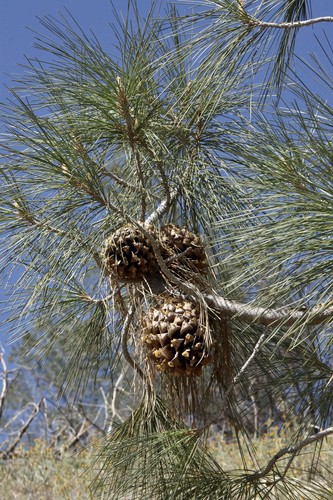
gray pine
Pinus sabiniana
An ethereal icon of the California foothills, the gray pine is easily recognized by its ghostly needles and massive, talon-like cones. It serves as a vital 'pantry' for woodland creatures in dry, rugged landscapes.
Quick Identification
Size
Grows 36-70 feet (11-21 meters) tall; cones are massive, 6-10 inches (15-25 cm) long and very heavy.
Colors
Ethereal gray-green needles; bark is dark gray to charcoal with deep furrows; mature cones are rich chocolate brown.
Key Features
- Distinctive multi-forked trunk that often splits close to the ground
- Wispy, see-through canopy with long, drooping 8-12 inch needles
- Massive woody cones featuring sharp, inward-curved 'talon' scales
- Bark with irregular scales and orange-tinted inner furrows
When You’ll See Them
Behavior
Unlike most pines that grow in a straight, columnar fashion, the gray pine is famous for its unique 'forked' growth habit. It often splits into two or more main stems low on the trunk, creating a signature Y-shape that stands out against the California foothills. This open structure allows light to pass through easily, giving the tree a ghostly, translucent appearance when viewed from a distance, which is why it is often called the 'ghost pine.'
Ecologically, this tree acts as a vital lifeline for foothill wildlife. It produces some of the largest and most calorie-dense seeds of any North American pine. Because the tree is highly drought-tolerant, it thrives in the hot, dry 'Upper Sonoran' zone where other conifers struggle. It doesn't compete for space in dense forests, instead preferring the open, sun-drenched slopes of oak woodlands.
EverydayEarth exclusive
Camera Tips
Capturing the gray pine on a trail camera is less about catching the tree 'moving' and more about using it as a high-traffic wildlife hub. The massive, nutrient-rich seeds (pine nuts) are a magnet for squirrels, scrub jays, and woodpeckers. To capture this activity, mount your camera directly on a lower branch or a nearby trunk facing the 'crown' where the cones are concentrated. Because the cones are heavy and often fall close to the base, a ground-level camera set 5-10 feet from the trunk can capture amazing footage of animals foraging for fallen seeds.
For the best visual results, pay attention to the lighting. The gray pine's needles are thin and translucent; they look spectacular when backlit by the sun. Aim your camera toward the west during the late afternoon to catch the 'halo' effect as sunlight passes through the wispy canopy. If your camera has a time-lapse mode, use it to capture the slow opening of the cone scales over several weeks in the late summer heat.
Since the gray pine often grows in hot, open environments, thermal triggers can sometimes be finicky due to heat shimmer. If you are targeting the birds or squirrels that visit the tree, increase your camera's sensitivity to 'High' and use a fast shutter speed to freeze the motion of wings. Avoid placing the camera too close to the sharp 'talons' of the cones, as the resin (pitch) is incredibly sticky and can easily smudge your lens or ruin the camera housing if it drips.
Similar Species
Species that look similar or are commonly confused with gray pine.
Frequently Asked Questions
Record gray pine at your habitat
Connect a camera to start building your own species record — AI identifies every visitor automatically.