Coulter pine
Pinus coulteri
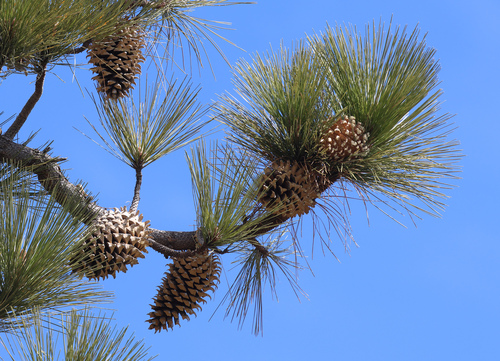
Home to the world's heaviest pine cones, the Coulter pine is a rugged survivor of California's rocky ridges. These 'widow-makers' and their long, blue-green needles create a striking silhouette against the coastal mountain skyline.
Quick Identification
Size
Height 10–24 m (33–79 ft); cones 20–40 cm (8–16 in) long and weighing up to 5 kg (11 lbs)
Colors
Dark gray-brown furrowed bark; needles are a distinctive gray-green to blue-green
Key Features
- Massive, heavy cones with sharp, hooked scales ('widow-makers')
- Long, stiff needles in bundles of three up to 12 inches long
- Deeply furrowed, dark gray-brown bark
- Pyramidal shape in youth, becoming broad and irregular with age
When You’ll See Them
Geographic range
Where Does the Coulter pine Live?
The Coulter pine is a true specialist of the California Floristic Province, native primarily to the coastal mountain ranges of Southern California in the United States and northern Baja California in Mexico. Its core range includes the Transverse and Peninsular Ranges, though fascinating isolated populations exist as far north as the San Francisco Bay Area and Mount Konocti. It is most frequently found clinging to rugged, sun-drenched slopes where other trees struggle to find purchase.
Basemap © OpenStreetMap contributors
Behavior
The Coulter pine is a slow-growing, resilient conifer that has adapted to thrive in the harsh, dry conditions of the California mountains. Unlike many other pine species that rely strictly on fire to release their seeds, the Coulter pine's massive cones will open naturally upon reaching maturity, though they also respond well to post-fire conditions. These trees are famous for their sheer weight and physical presence; they produce the heaviest cones of any pine tree in the world, equipped with thick, claw-like scales that protect the seeds from foragers until they are fully ripe.
Ecologically, the Coulter pine acts as a vital anchor for mountain slope ecosystems. It provides significant structural habitat for various birds and mammals and is a primary food source for specialized seed-eaters. While it doesn't 'move' in the animal sense, the tree's growth pattern is a slow-motion response to its environment, often leaning away from prevailing winds on exposed ridges or spreading its branches wide in more sheltered oak woodlands.
EverydayEarth exclusive
Camera Tips
When setting up a trail camera to capture the Coulter pine, your primary focus should be on the tree as a hub for wildlife. These trees are magnets for Western Gray Squirrels and Scrub Jays, especially during the late summer and autumn when the massive cones begin to ripen and dry. To capture these foragers in action, mount your camera 5 to 7 feet high on a neighboring tree or a sturdy post, angling it toward the middle-to-lower branches where the cones are most accessible to climbing mammals.
The most dramatic feature of the Coulter pine is its 'widow-maker' cone. To document these giants, use a camera with a high-resolution time-lapse feature pointed toward the canopy. This allows you to capture the slow opening of the scales or the sudden, heavy fall of a cone after a windstorm. Be extremely careful with camera placement; never mount a camera directly under a cluster of mature cones, as a falling 10-pound cone can easily destroy hardware or shift your mount entirely.
For the best visual results, utilize the natural lighting of the California 'Golden Hour.' The low-angle sunlight of early morning or late afternoon beautifully highlights the deeply furrowed texture of the bark and the resinous sheen on the cone scales. If your camera has adjustable exposure settings, slight underexposure can help prevent the silvery-green needles from looking washed out in the bright midday sun.
During the winter months, Coulter pines often serve as a windbreak for birds seeking shelter. A camera set to high sensitivity can capture small nuthatches or woodpeckers scouting the bark for insects. If you are in a higher elevation area where snow occurs, the contrast of the dark, rugged bark against the white snow makes for stunning architectural photos of the tree. Ensure your camera is secured with a heavy-duty strap, as the mountain ridges where these trees live are prone to high wind gusts.
Similar Species
Species that look similar or are commonly confused with Coulter pine.
Frequently Asked Questions
Record Coulter pine at your habitat
Connect a camera to start building your own species record — AI identifies every visitor automatically.