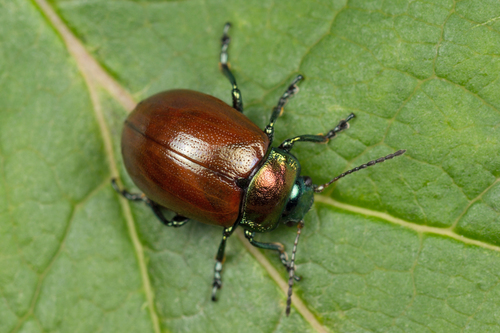
Knotgrass leaf beetle
Chrysolina polita
A gem of the undergrowth, the Knotgrass leaf beetle brings a splash of metallic brilliance to the garden. Often found basking on mint leaves, its polished copper and green shell is a masterclass in natural engineering.
Quick Identification
Size
6.5–8.5 mm (0.25–0.33 inches) in length
Colors
Bicolored with a metallic green or bronze-green head and thorax, and shiny metallic reddish-brown or coppery elytra (wing cases).
Key Features
- Distinctly bicolored appearance with green front and reddish-brown back
- Highly polished, metallic sheen on all body parts
- Rounded, convex body shape typical of leaf beetles
- Fine, irregular punctures visible on the wing covers
When You’ll See Them
Behavior
The Knotgrass leaf beetle is a slow-moving but visually striking insect often found clinging to the stems and leaves of its favorite host plants. Unlike some of its more flighty relatives, this beetle tends to stay put once it finds a suitable feeding ground, making it a wonderful subject for patient observers. They are most active during the day, using their strong legs to navigate the vertical terrain of garden herbs and wild grasses.
As the name suggests, they have a particular affinity for plants like knotgrass, but in backyard settings, they are frequently discovered on various species of mint. When threatened, they exhibit a common beetle defense mechanism called 'thanatosis,' where they tuck in their legs and drop to the ground, appearing dead and becoming nearly impossible to find among the soil and leaf litter. They overwinter as adults, tucked away in the soil or under dense vegetation, emerging in early spring to mate and lay eggs.
EverydayEarth exclusive
Camera Tips
Capturing the Knotgrass leaf beetle on a backyard camera requires a pivot from traditional trail cam setups. Because these beetles are less than a centimeter long, a standard wide-angle trail camera will only capture them as tiny, indistinguishable dots. To get high-quality footage, you must use a camera with a macro lens or a specialized close-up attachment. Focus your efforts on 'host plant hotspots'—if you have a patch of wild mint, water mint, or knotgrass, this is where you should station your equipment. Position the lens just 4 to 8 inches away from the foliage for the best results.
Lighting is your biggest challenge and your greatest asset with this species. Their 'polished' shells act like tiny mirrors, which can create harsh glares if you use a powerful LED flash at close range. For the most vibrant results, rely on natural, diffused sunlight. If your camera allows for it, set a high shutter speed to capture the fine details of their legs and antennae without motion blur. A 'time-lapse' mode set to fire every 30 seconds can be a great way to monitor a specific plant over several hours to see when the beetles arrive to feed.
Placement height is critical; you want the camera at the same level as the mid-height leaves of the host plant, usually about 6 to 12 inches off the ground. Using a small tripod or a flexible 'gorilla' mount attached to a garden stake is much more effective than mounting to a tree. Since these beetles are most active in warm, humid conditions, try to schedule your recording sessions for the morning after a light rain or on warm, overcast days when the metallic colors of their elytra will appear deepest and most saturated on film.
Similar Species
Species that look similar or are commonly confused with Knotgrass leaf beetle.
Frequently Asked Questions
Record Knotgrass leaf beetle at your habitat
Connect a camera to start building your own species record — AI identifies every visitor automatically.