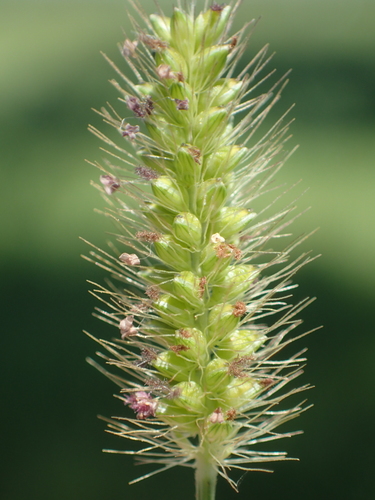
knotroot bristlegrass
Setaria parviflora
A hardy perennial known for its shimmering, 'foxtail' seed heads and unique, knotty roots. This versatile grass is a vital hub for backyard birds and butterflies across the Americas.
Quick Identification
Size
30–120 cm (1–4 ft) in height; seed heads typically 2–10 cm (0.8–4 in) long
Colors
Bright green leaves; seed heads feature bristles ranging from yellow and tawny orange to deep purple
Key Features
- Cylindrical, fuzzy 'foxtail' seed heads
- Short, knotty rhizomes at the base of the plant
- 4 to 12 bristles located below each spikelet
- Perennial growth habit, unlike similar annual grasses
When You’ll See Them
Geographic range
Where Does the knotroot bristlegrass Live?
Knotroot bristlegrass is native to the vast landscapes of the Americas, boasting a massive footprint that spans from the temperate United States down through the Caribbean and Central America into the heart of South America. It is a highly adaptable resident found in almost every state in the lower 48, though it is most prolific in the humid eastern and southern regions. While it thrives in its native range, it has also been introduced to parts of Eurasia and the Pacific, where it often establishes itself in disturbed soils and agricultural fringes.
Basemap © OpenStreetMap contributors
Behavior
Knotroot bristlegrass is a resilient perennial grass that distinguishes itself from its annual 'foxtail' relatives through its hardy, knotty root system. While many grasses rely solely on seeds to propagate, this species utilizes short, thick underground rhizomes to form stable, long-lasting clumps. This makes it a permanent fixture in the landscape, providing consistent cover and structure for small ground-dwelling creatures throughout the year.
As a member of the Poaceae family, its primary ecological role involves soil stabilization and providing a vital food source. In the late summer and autumn, it produces dense, bristly flower spikes that eventually heavy with seeds. These seeds are a high-energy resource for many backyard bird species. Furthermore, it serves as a larval host for several species of skipper butterflies, making it a cornerstone of local pollinator ecosystems.
EverydayEarth exclusive
Camera Tips
Capturing the subtle beauty of knotroot bristlegrass with an AI camera requires a different approach than filming moving animals. To get the best shots of the 'bristles' that give the plant its name, position your camera at a low angle, roughly 1 to 2 feet off the ground. Aim for a back-lit setup during the 'golden hour'—the hour after sunrise or before sunset. The low sun will catch the translucent bristles, making the seed head appear to glow with a halo of light.
Because this grass is a favorite for birds and insects, your camera's motion sensor will likely be triggered by visitors rather than the plant itself. To capture these interactions, focus your camera directly on a mature seed head. Many AI-powered cameras have a 'Time-Lapse' mode; this is perfect for knotroot bristlegrass, allowing you to see the seed head sway in the wind or watch the gradual transition from green to tawny yellow over several weeks in late summer.
Be mindful of wind sensitivity. If your camera is set to record every time the grass moves, a breezy day could fill your storage with empty clips. Use the 'Activity Zone' feature in your camera app to mask out the upper parts of the grass stalks if you only want to capture ground-dwelling animals passing by, or lower the sensitivity slightly. However, if you want to see the various skipper butterflies that use the grass as a host, keep the sensitivity high during the peak of summer.
Similar Species
Species that look similar or are commonly confused with knotroot bristlegrass.
Frequently Asked Questions
Record knotroot bristlegrass at your habitat
Connect a camera to start building your own species record — AI identifies every visitor automatically.