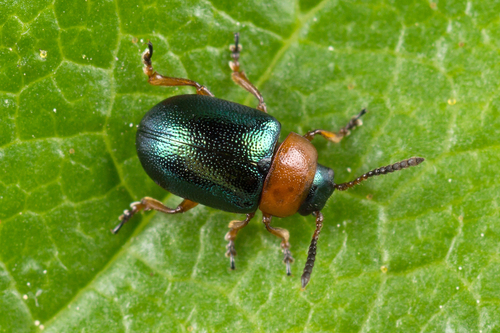
Knotweed Leaf Beetle
Gastrophysa polygoni
Meet the jewel of the garden weeds. With its shimmering metallic armor and vibrant orange accents, the Knotweed Leaf Beetle is a tiny masterpiece of nature often hiding in plain sight on the undersides of leaves.
Quick Identification
Size
4–5 mm (0.16–0.20 inches) in length
Colors
Brilliant metallic green or blue wing cases (elytra) with a contrasting bright orange or reddish-brown thorax and legs; breeding females have greatly enlarged, orange abdomens.
Key Features
- Metallic green or blue wing cases
- Bright orange or reddish thorax
- Orange legs with dark tarsal tips
- Oval-shaped body, less than 5mm long
- Breeding females have a significantly swollen orange abdomen
When You’ll See Them
Behavior
The Knotweed Leaf Beetle is a charming but industrious resident of the backyard garden, best known for its striking color contrast and unique reproductive physiology. While the males remain relatively small and streamlined, the females undergo a dramatic transformation called physogastry when carrying eggs. Their abdomens swell so significantly that the metallic wing cases are pushed aside, making the beetle look like a tiny, walking orange berry with a green head.
These beetles are generally docile and slow-moving, spending the majority of their time on the underside of host plant leaves. They are not known to be strong fliers, preferring to crawl from leaf to leaf as they forage. When threatened, they may drop from the foliage into the leaf litter below to disappear from predators, or they may secrete a defensive fluid to deter ants and birds.
EverydayEarth exclusive
Camera Tips
Capturing the Knotweed Leaf Beetle on camera requires a dedicated macro approach due to their diminutive 5mm size. Because they are so small, standard trail cameras may struggle to trigger or focus; instead, use a specialized macro-lens attachment or an AI-powered camera designed for backyard insects. Position your camera extremely close to the host plants—specifically common knotgrass or sorrel—focusing on the mid-level leaves where the beetles prefer to congregate. A height of 4 to 8 inches off the ground is usually the 'sweet spot' for these low-dwelling insects.
Lighting is your biggest challenge and your greatest asset with this species. The metallic green wing cases are highly reflective and can easily wash out in direct midday sun, creating 'hot spots' in your photos. For the best results, position your camera in an area with bright but filtered light, such as under a garden canopy, or aim for the 'golden hours' of early morning and late afternoon. This will bring out the iridescent shimmer of their elytra and the rich orange of their thorax without the harsh glare.
If you are looking for that 'hero shot' of a swollen female, timing is everything. These 'physogastric' females are most common in late spring and early summer. Because they are heavier and slower in this state, they make excellent subjects for time-lapse photography. Set your camera to take a shot every 30 seconds while they are active on a leaf; you might capture the fascinating process of them laying their yellow, spindle-shaped eggs in neat rows on the leaf's underside.
To attract them to a specific spot for your camera, avoid using pesticides and leave a small, wild patch of 'weeds' like dock or knotgrass. These beetles aren't attracted to traditional baits like sugar or fruit; they are entirely focused on their host plants. By identifying a leaf with small, circular holes (telltale signs of their feeding), you can place your camera with high confidence that the beetle is nearby and will return to finish its meal.
Similar Species
Species that look similar or are commonly confused with Knotweed Leaf Beetle.
Green Dock Beetle
The Green Dock Beetle is entirely metallic green or bronze, whereas the Knotweed Leaf Beetle has a distinct orange thorax and legs.
Cereal Leaf Beetle
Cereal Leaf Beetles have a similar orange thorax but their wing cases are usually a darker, flatter blue and they prefer grasses over knotweed.
Frequently Asked Questions
Record Knotweed Leaf Beetle at your habitat
Connect a camera to start building your own species record — AI identifies every visitor automatically.