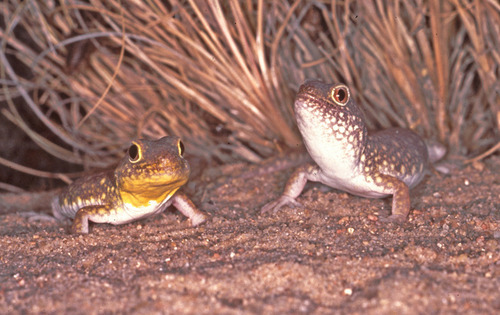
Koch's Chirping Gecko
Ptenopus kochi
The vocal 'voice of the Namib,' Koch's Chirping Gecko is a desert-dwelling marvel that announces its presence with a rhythmic desert chorus. Found only in the sands of Namibia, this master of the dunes lives a secret life beneath the surface.
Quick Identification
Size
Snout-vent length of 50-60 mm (2-2.4 inches); total length including tail reaches up to 110 mm (4.3 inches); weight approximately 6-10 grams.
Colors
Pale sandy yellow to light brown base color with darker brown or reddish-orange irregular blotches and speckles; creamy white underside; juveniles often show more distinct banding.
Key Features
- Broad, disproportionately large head with blunt snout
- Fringed scales on toes acting like 'sand-shoes' for digging
- Large, gold-rimmed eyes with vertical pupils
- High-pitched, repetitive 'clicking' or 'barking' vocalization
When You’ll See Them
Geographic range
Where Does the Koch's Chirping Gecko Live?
Native to the African continent, Koch's Chirping Gecko is a highly localized endemic found exclusively within the Namib Desert of Namibia. Its core range is restricted to the central Namib, particularly the gravel plains and sandy interdune spaces between the Kuiseb and Swakop rivers. Because of its very specific habitat requirements, it is not found anywhere else in the world and has no known introduced populations.
Basemap © OpenStreetMap contributors
Behavior
Koch's Chirping Gecko is a fascinating desert specialist known primarily for its vocal nature. Unlike most reptiles, these geckos are highly auditory; males spend their evenings at the entrance of their burrows, emitting a series of sharp, percussive chirps to establish territory and attract mates. They are master excavators, digging deep, spiraling burrows in the firm sand of interdune areas to escape the blistering heat of the Namibian day.
Strictly nocturnal, they emerge only after the sun has set and the sand temperature has dropped. They are sit-and-wait predators, often positioned just outside their burrow entrance to ambush passing insects. Despite their small size, they are remarkably bold when calling, though they will retreat into their tunnels at the slightest vibration of a predator's footstep.
EverydayEarth exclusive
Camera Tips
To capture Koch's Chirping Gecko, you must think low. These geckos rarely leave the ground, so place your camera just a few inches above the sand. The best technique is to locate a colony by ear—listen for the characteristic 'chirping' at dusk—and find the small, crescent-shaped burrow entrances. Position your camera facing a burrow entrance from a distance of about 2 feet, using a macro-focus setting if your device supports it.
Since they are active in total darkness, a camera with high-quality infrared (IR) or 'no-glow' LEDs is essential. These geckos are sensitive to vibrations, so avoid frequent visits to the camera site. Mounting the camera on a small tripod or half-buried stake is more effective than using a traditional tree mount in the treeless desert environment.
While they don't respond to traditional bait like fruit or meat, a soft LED light nearby (not pointed directly at the burrow) can sometimes attract the insects they prey upon, bringing the gecko into clear view for the lens. Ensure your camera is weather-sealed against fine desert dust, which can easily penetrate standard housings.
Similar Species
Species that look similar or are commonly confused with Koch's Chirping Gecko.
Frequently Asked Questions
Record Koch's Chirping Gecko at your habitat
Connect a camera to start building your own species record — AI identifies every visitor automatically.