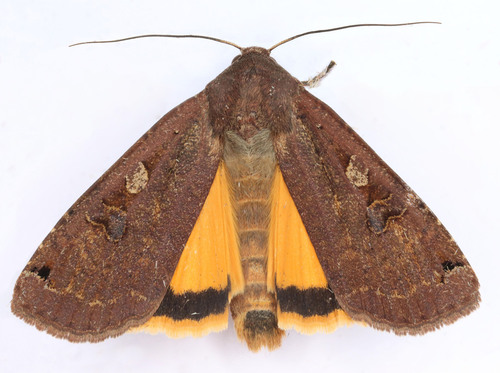
Large Yellow Underwing
Noctua pronuba
A frequent visitor to backyard porch lights, the Large Yellow Underwing hides a brilliant secret beneath its drab exterior. This common moth is a master of 'flash coloration,' using a hidden burst of golden-yellow to startle predators.
Quick Identification
Size
Wingspan of 50–60 mm (2.0–2.4 inches); body length approximately 25–30 mm (1.0–1.2 inches).
Colors
Forewings range from light clay-tan to dark reddish-brown; hindwings are bright orange-yellow with a single narrow black band.
Key Features
- Bright yellow-orange hindwings with a single black border
- Small black dot located near the leading edge of the forewing tip
- Kidney-shaped (reniform) mark on the forewing
- Stocky, furry body with wings folded flat when resting
When You’ll See Them
Behavior
The Large Yellow Underwing is a master of camouflage and startle tactics. During the day, it rests on tree bark or among dried leaves, where its dull brown forewings make it nearly invisible to predators. If disturbed, it suddenly takes flight, flashing its brilliant yellow hindwings. This sudden burst of color is designed to confuse birds, giving the moth a vital second to fly a short distance and dive back into cover, where it instantly disappears by closing its wings.
These moths are highly attracted to artificial light sources and are frequent visitors to gardens and even indoor spaces during the summer months. They are remarkably robust and strong fliers, often traveling long distances during migration. Unlike many delicate moth species, the Large Yellow Underwing is quite 'skittery' on the ground, often running or crawling rapidly through grass rather than immediately taking flight.
EverydayEarth exclusive
Camera Tips
To capture high-quality images of the Large Yellow Underwing, set up your AI-powered camera near a white vertical surface, such as a garden fence or a hung bedsheet, and illuminate it with a UV light or a bright LED. This species is highly attracted to 'light-trapping' setups. Position your camera on a tripod roughly 18-24 inches from the surface to allow the macro lens to focus on the intricate wing patterns as the moth rests.
For a more natural 'action' shot, try 'moth sugaring.' Mix overripe bananas, brown sugar, and a splash of dark beer into a thick paste and paint it onto a tree trunk at chest height. Mount your camera nearby. The Large Yellow Underwing is an avid feeder and will spend several minutes at a sugar bait, providing ample time for your camera to trigger and capture the moth with its proboscis extended. This setup is particularly effective on warm, humid, and overcast nights when moth activity is at its highest.
Because these moths are prone to sudden movement, use a fast shutter speed setting if your camera allows. To see the famous yellow underwings, look for 'Photo+Video' modes; the still image will likely show the camouflaged forewings, but the video will capture the flash of orange as the moth departs the scene. In late summer, try placing your camera lower to the ground near nectar-rich ground-cover plants, as this species often stays low to the foliage.
Similar Species
Species that look similar or are commonly confused with Large Yellow Underwing.
Frequently Asked Questions
Record Large Yellow Underwing at your habitat
Connect a camera to start building your own species record — AI identifies every visitor automatically.