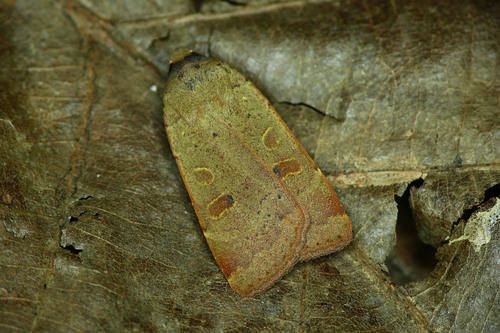
Lesser Yellow Underwing
Noctua comes
A common yet stunning visitor to the night garden, the Lesser Yellow Underwing carries a secret splash of saffron hidden beneath its camouflaged exterior. This hardy moth is a perfect subject for backyard explorers looking to dive into the world of nocturnal pollinators.
Quick Identification
Size
Wingspan of 35–45 mm (1.4–1.8 inches)
Colors
Forewings vary from clay-brown to reddish-grey; hindwings are bright yellow-orange with a thick black border and a central black crescent.
Key Features
- Bright yellow hindwings with a black border and a distinct central black crescent (lunule)
- Forewings are highly variable in color but usually feature a subtle kidney-shaped mark
- Rests with wings folded flat over the back in a tent-like shape
- Medium-sized, stout body covered in fine hairs
When You’ll See Them
Behavior
The Lesser Yellow Underwing is a master of camouflage by day and a high-energy navigator by night. During daylight hours, it rests motionless on tree trunks or among leaf litter, where its mottled forewings make it nearly invisible to birds and other predators. If it is disturbed, it utilizes a fascinating defense mechanism known as 'startle coloration.' It suddenly flashes its brilliant yellow hindwings, a burst of color that can momentarily confuse a predator, allowing the moth a split second to fly to safety.
Unlike many moth species that are highly specialized, the Lesser Yellow Underwing is a generalist and a frequent visitor to human-altered landscapes. It is a strong flyer and is highly attracted to both artificial light sources and sweet, fermenting scents. In the garden, you will often find them darting between late-summer blooms or resting near porch lights on humid evenings.
EverydayEarth exclusive
Camera Tips
To capture high-quality images of the Lesser Yellow Underwing, your best strategy is to set up a 'moth station' in a sheltered part of your yard. Use a white cotton sheet draped over a fence or a clothesline and illuminate it with a UV (blacklight) lamp or a bright LED work light. Set your camera on a tripod about 2 to 3 feet away. Because these moths are small, you will need a camera with good macro capabilities or a minimum focus distance that allows for close-up detail.
If you are using a motion-activated trail camera, ensure it is set to its highest sensitivity and positioned near a nectar source like a butterfly bush (Buddleia). For the best results, use a camera that offers 'Night Mode' with infrared flash to avoid overexposing the moth's reflective wings. To see the 'yellow' that gives them their name, you'll want to capture them in flight or just as they land; setting your camera to 'Burst Mode' or a 10-second video clip is the most effective way to catch that brief flash of hindwing color.
Another excellent way to lure them into camera range is 'sugaring.' Mix overripe bananas, dark brown sugar, and a bit of molasses into a thick paste and paint it onto a tree trunk at eye level. Position your camera 4 feet away, angled slightly upward. This method is particularly effective on warm, overcast nights with very little wind, as the scent carries well and the moths feel more secure foraging in the dark.
Similar Species
Species that look similar or are commonly confused with Lesser Yellow Underwing.
Frequently Asked Questions
Record Lesser Yellow Underwing at your habitat
Connect a camera to start building your own species record — AI identifies every visitor automatically.