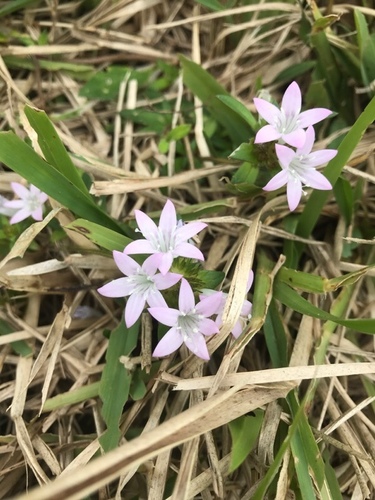
largeflower Mexican clover
Richardia grandiflora
Transforming lawns into blankets of 'Florida snow,' the largeflower Mexican clover is a resilient, low-growing wildflower that provides a crucial nectar highway for backyard pollinators.
Quick Identification
Size
Grows 2-4 inches (5-10 cm) tall; flowers are roughly 0.5-0.75 inches (12-20 mm) in diameter.
Colors
Flowers range from brilliant white to pale pink or lavender-purple; foliage is a deep, textured green.
Key Features
- Funnel-shaped flowers with 6 pointed lobes
- Opposite, oval-shaped leaves with visible hairs on margins
- Prostrate growth habit that forms dense, mat-like ground cover
- Stiff, hairy stems that root at the nodes
When You’ll See Them
Behavior
Largeflower Mexican clover, often colloquially called "Florida snow," is a resilient perennial that behaves as an opportunistic ground cover. It is best known for its ability to colonize disturbed soils and well-manicured lawns, where it spreads horizontally to form dense, flowering mats. While some homeowners consider it a weed due to its ability to outcompete turfgrass, it provides a vital service as a hardy nectar source in urban environments where other wildflowers might be scarce.
This plant is highly adapted to human-altered landscapes and is famously resistant to mowing; it simply adjusts its growth height to stay below the mower blades. It interacts with the local ecosystem primarily as a pollinator magnet, drawing in a wide variety of bees, butterflies, and small wasps during the daylight hours. During the heat of the day, its star-shaped blooms remain open to soak up the sun, providing a consistent food source for the backyard's smallest inhabitants.
EverydayEarth exclusive
Camera Tips
To capture the beauty of largeflower Mexican clover, you need to think low. Since this plant rarely exceeds four inches in height, place your camera on a ground-level mount or a small tripod just an inch or two above the grass. For the best AI-triggered shots of the insects it attracts, angle the camera slightly upward. This "bug's eye view" not only makes the small flowers look majestic but also captures the underside of visiting butterflies and bees against the sky, which helps with AI identification.
Because this plant doesn't move much on its own, your motion-activated camera might not trigger unless a pollinator arrives or the wind is particularly strong. To get the best results, use the time-lapse setting on your camera. Set it to take a photo every 15 to 30 minutes from sunrise to sunset. This will allow you to watch the "Florida snow" effect as the flowers open and close in response to light levels, and it ensures you don't miss the fast-moving pollinators that visit between trigger intervals.
Lighting is crucial for this species. White and pale lavender flowers can easily "blow out" (become featureless white blobs) in harsh midday sun. If possible, position your camera so the flowers are in bright but filtered light, or set your camera’s exposure compensation to -0.5 or -1.0 to preserve the delicate details of the petals. If you are targeting the pollinators specifically, early morning light (8-10 AM) provides the best contrast and the highest activity levels for honeybees and skippers.
Similar Species
Species that look similar or are commonly confused with largeflower Mexican clover.
Frequently Asked Questions
Record largeflower Mexican clover at your habitat
Connect a camera to start building your own species record — AI identifies every visitor automatically.