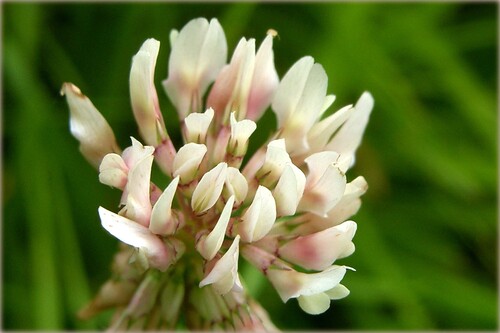
white clover
Trifolium repens
The unsung hero of the backyard, white clover is more than just a lawn dweller—it's a nitrogen-fixing powerhouse and a bustling airport for local pollinators.
Quick Identification
Size
Height: 5–15 cm (2–6 inches); Leaflets: 1–2 cm (0.4–0.8 inches) long
Colors
Bright green leaves with white or pale-green 'V' markings; white to creamy-white flower heads, occasionally tinged with pink
Key Features
- Three rounded leaflets forming a trefoil shape
- White, globe-shaped flower clusters (heads) on long stalks
- Creeping stems (stolons) that root where they touch the ground
- Distinctive white 'V' or watermark on the center of each leaflet
When You’ll See Them
Behavior
White clover is a hardy, herbaceous perennial that spreads aggressively through a network of creeping stems called stolons. Unlike many other garden plants, it forms a symbiotic relationship with soil bacteria to 'fix' nitrogen, essentially creating its own fertilizer and improving the soil for neighboring plants. This makes it a foundational species in healthy backyard ecosystems.
One of the most fascinating behaviors of white clover is its nyctinasty—the 'sleep' movements of its leaves. As evening approaches, the leaflets fold upward and together, a response thought to protect the plant from nocturnal herbivores or conserve moisture. During the day, the flower heads are a hub of social activity, secreting high-quality nectar that attracts a diverse community of pollinators, particularly honeybees and bumblebees.
EverydayEarth exclusive
Camera Tips
Capturing the secret life of white clover requires a different approach than filming mobile wildlife. To see the plant in action, set your camera to a time-lapse mode. Positioning a camera just 4 to 6 inches off the ground at a 45-degree angle will allow you to witness the 'sleep' cycle as the leaves fold at sunset and unfurl at dawn. This low-angle perspective also provides an immersive look at the creeping stolons as they slowly colonize new patches of soil over several weeks.
Because white clover is a primary food source for backyard visitors, use a patch of it as a natural 'stage' for your camera. Ground-dwelling mammals like Eastern Cottontails and Groundhogs frequently visit clover patches during the 'golden hours' of dawn and dusk. To capture these interactions, place your camera on a small tripod or garden stake about 10 feet away from a dense clover patch, ensuring the focus is sharp on the flower heads where the animals are most likely to graze.
For those interested in macro-wildlife, white clover is an unbeatable target for capturing insect diversity. Position your camera as close as the minimum focal distance allows—often 12 to 20 inches for most trail cams—and aim it at a cluster of fresh white blooms. On sunny, still days between 10 AM and 2 PM, you can document a constant rotation of honeybees, leafcutter bees, and small butterflies like the Eastern Tailed-Blue. High-frame-rate settings are ideal here to catch the fast-moving wings of visiting pollinators.
Lastly, don't overlook the winter months. While the flowers disappear, the leaves often stay green under the snow. Placing a camera near a clover patch during a thaw can help you capture sightings of birds and small rodents searching for rare winter greens. If your camera has adjustable sensitivity, turn it up; the slight movement of a clover leaf under a foraging sparrow is subtle but makes for an excellent close-up shot.
Similar Species
Species that look similar or are commonly confused with white clover.
Frequently Asked Questions
Record white clover at your habitat
Connect a camera to start building your own species record — AI identifies every visitor automatically.