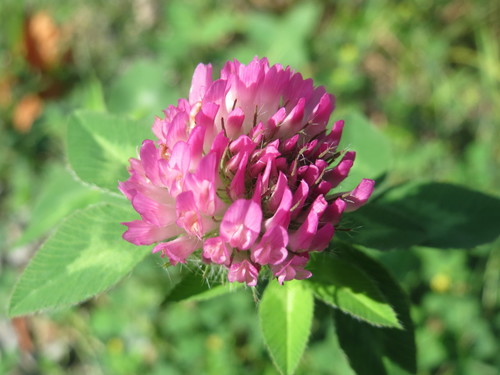
Red Clover
Trifolium pratense
The backbone of a healthy meadow, Red Clover is more than just a wildflower—it's a nitrogen-fixing powerhouse and a favorite pit stop for busy bumblebees. Its vibrant pink blooms and 'chevron' leaves are the hallmarks of a thriving, chemical-free backyard.
Quick Identification
Size
Stems reach 20–80 cm (8–31 in) tall; flower heads are 2–3 cm (0.8–1.2 in) in diameter.
Colors
Flower heads are deep pink to magenta or reddish-purple; leaves are green with a distinct pale white 'V' or chevron marking.
Key Features
- Round, dense flower heads made of many tubular florets
- Trifoliate leaves (sets of three leaflets)
- Distinctive pale white 'V' marking on the center of each leaf
- Softly hairy stems and leaves
- Nitrogen-fixing root system
When You’ll See Them
Behavior
Red Clover is a perennial herbaceous plant that plays a critical role in backyard ecosystems as a 'soil builder.' It forms a symbiotic relationship with specialized bacteria in its root nodules, which allows it to take nitrogen from the air and 'fix' it into the soil, naturally fertilizing the ground for surrounding plants. While it remains stationary, it exhibits a behavior called nyctinasty, where its leaves fold upward at night to protect the plant from moisture loss and dew.
In a backyard setting, Red Clover acts as a primary hub for social insects. Its deep, nectar-rich tubes are specifically adapted for long-tongued pollinators. Because of this, it is one of the most important food sources for various species of bumblebees, who are among the few insects strong and long-tongued enough to access the nectar. For humans, it is a symbol of a healthy, chemical-free lawn and is often used in herbal traditions and as a high-protein forage for wildlife.
EverydayEarth exclusive
Camera Tips
When photographing Red Clover, the goal is often to capture the vibrant life it supports. To get the best results from a backyard camera, set your device on a tripod at a low 'insect-eye' level—about 6 to 12 inches off the ground. Position the camera facing a particularly dense cluster of blooms. If your camera has a macro mode or a close-focus setting, this is the time to use it, as the intricate structure of the individual florets makes for a stunning visual centerpiece.
For trail cameras, look for a patch of clover that shows signs of grazing (flattened stems or nipped leaves). Red Clover is a favorite snack for Eastern Cottontails and Groundhogs. Mount your camera on a short stake roughly 12 inches high, angled slightly downward toward the patch. Because clover is highly reflective in the midday sun, try to position the camera so the sun is at the 'back' of the lens or use a polarizing filter to avoid blowing out the bright pink colors of the flower heads.
Time-lapse photography is particularly rewarding with Red Clover. Set your camera to take a photo every 15 minutes during the spring when the buds first appear. This allows you to document the 'bloom cycle' from a tight green bud to a full magenta globe. Additionally, because the leaves 'sleep' at night by folding upward, a 24-hour time-lapse can capture the plant's daily movement, which is a fascinating and often overlooked aspect of plant behavior.
Finally, focus on the peak pollinator hours between 10 AM and 2 PM on warm, still days. High-speed video triggers are essential for capturing the split-second landings of bumblebees and butterflies. If your camera allows for it, increase the frame rate (FPS) to at least 60 or 120 so you can replay the footage in slow motion, revealing the mechanical way a bee pries open the clover's florets to reach the nectar inside.
Similar Species
Species that look similar or are commonly confused with Red Clover.
White Clover
Much shorter, with white flower heads and stems that creep along the ground rather than growing upright.
Crimson Clover
Features elongated, blood-red flower spikes rather than the round pink heads of Red Clover.
Alsike Clover
Flowers are a mix of white and pale pink, and its leaves lack the distinctive white 'V' or chevron mark found on Red Clover.
Frequently Asked Questions
Record Red Clover at your habitat
Connect a camera to start building your own species record — AI identifies every visitor automatically.