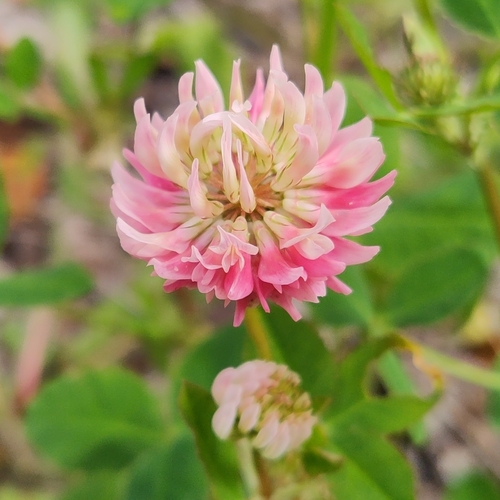
Alsike clover
Trifolium hybridum
A charming and hardy bicolored wildflower, Alsike clover is a favorite of honeybees and a master of thriving in damp, cool meadows.
Quick Identification
Size
15-40 cm (6-16 inches) in height; flower heads 1-2.5 cm (0.4-1 inch) wide
Colors
Bicolored flowers with white bases and rosy-pink tips; solid emerald green foliage
Key Features
- Trifoliate leaves lack the white 'V' watermark seen in Red or White clover
- Flower heads grow on long stalks originating from the leaf axils
- Bicolored petals that transition from white to pale pink
- Smooth, hairless stems and leaves
When You’ll See Them
Geographic range
Where Does the Alsike clover Live?
Originally native to the temperate regions of mainland Europe and Western Asia, Alsike clover has successfully traveled across the globe as both a fodder crop and a wild pioneer. It is now a common sight throughout the British Isles and has become widely naturalized across North America, from the subarctic reaches of Canada to the temperate United States. It flourishes in nearly any cool-temperate climate where the soil remains consistently moist, having established significant populations in parts of South America and Oceania as well.
Basemap © OpenStreetMap contributors
Behavior
Alsike clover is a resilient perennial that often functions as a biennial, especially in managed landscapes. Unlike the common White clover which spreads via creeping runners (stolons), Alsike grows in a more upright or semi-erect fashion. It is remarkably sturdy, often found leaning against sturdier grasses for support while it reaches toward the sunlight. Its growth cycle is heavily influenced by moisture; it thrives in damp conditions where other legumes might suffer from root rot.
This plant is a powerhouse of soil health and biodiversity. It forms a symbiotic relationship with soil bacteria to fix nitrogen, naturally fertilizing the ground around it. For humans and backyard observers, its most prominent 'behavior' is its role as a high-traffic pollinator station. From late spring through autumn, the blossoms produce copious amounts of nectar, attracting a constant stream of bees and butterflies, making it a focal point for any nature-watching camera setup.
EverydayEarth exclusive
Camera Tips
To capture the best images of Alsike clover, you need to think like a macro photographer. Since the plant is relatively low-growing, mount your AI-powered camera on a ground spike or a very low tripod, roughly 6 to 10 inches from the ground. Aim for a side-profile shot of the flower heads to showcase the distinct 'stalked' nature of the blossoms growing from the leaf axils, which is a key identification feature. If your camera has a macro lens or high-resolution sensor, position it close enough to capture the delicate transition of color from the white base of the flower to the pink tip.
Because Alsike clover is a stationary subject, the 'action' comes from its visitors. Use this species as a natural focal point for pollinator activity. Set your camera's trigger sensitivity to high and use a fast shutter speed to freeze the wings of visiting honeybees, bumblebees, and butterflies. The best time for this is between mid-morning and mid-afternoon on sunny days when nectar production is at its peak. This is when you will see the most diverse range of insect life interacting with the blooms.
Time-lapse photography is another excellent way to utilize Alsike clover. Set your camera to take one photo every 10 to 15 minutes over several days. This will allow you to see the flower heads 'track' the sun and eventually watch the transition as the bicolored petals fade to brown and droop downward after pollination. Ensure the camera is sheltered from high winds, as the tall, thin stems of Alsike clover can sway significantly, which might cause motion blur in your time-lapse frames.
Finally, consider the lighting and moisture. Alsike clover looks its best immediately after a morning rain or a heavy dew. The hairless leaves catch water droplets beautifully, and the soft, overcast light after a storm prevents the white parts of the flower from being overexposed in your photos. If you are using an AI camera that identifies species, make sure the leaves are clearly visible in the frame, as the lack of a 'V' mark on the leaf is the primary way the AI will distinguish it from Red or White clover.
Similar Species
Species that look similar or are commonly confused with Alsike clover.
White Clover
White clover has a distinct white 'V' mark on its leaves and creeps along the ground using runners, whereas Alsike grows more upright and lacks leaf markings.
Red Clover
Red clover features much larger, fuzzy flower heads and hairy stems, while Alsike clover is completely smooth and hairless.
Frequently Asked Questions
Record Alsike clover at your habitat
Connect a camera to start building your own species record — AI identifies every visitor automatically.