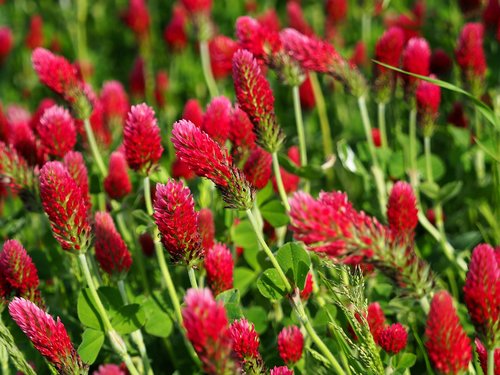
crimson clover
Trifolium incarnatum
Transforming spring meadows into seas of ruby-red, crimson clover is more than just a pretty face—it's a nitrogen-fixing powerhouse and a pollinator's paradise. This striking wildflower is a favorite for backyard naturalists looking to support local biodiversity.
Quick Identification
Size
Grows to a height of 20–50 cm (8–20 in) with flower heads measuring 2.5–6 cm (1–2.4 in) in length.
Colors
Brilliant crimson to ruby-red flower spikes; vibrant green trifoliate leaves often featuring a slightly darker or lighter central chevron.
Key Features
- Elongated, conical flower spikes composed of deep red florets
- Trifoliate leaves with three rounded, soft-to-the-touch leaflets
- Sturdy, upright stems covered in fine, silvery hairs
When You’ll See Them
Geographic range
Where Does the crimson clover Live?
Native to the Mediterranean regions of Southern Europe and parts of Southwest Asia, crimson clover has become a beloved globetrotter. It is now widely naturalized throughout the United Kingdom and much of North America, where it is frequently spotted lining highways and enriching pastures from the Southeastern United States to the Pacific Northwest. This hardy plant also maintains significant introduced populations in temperate parts of Australia and Japan, thriving wherever mild winters and moist springs prevail.
Basemap © OpenStreetMap contributors
Behavior
Crimson clover is a vigorous annual herb that behaves as a quintessential pioneer species, rapidly colonizing open ground with its lush, upright growth. Unlike many of its creeping relatives, this species stands tall, focusing its energy on a singular, spectacular blooming event in the spring. It operates on a strict annual lifecycle, germinating in the cool autumn or early spring, blooming vibrantly to attract pollinators, and then setting seed before the heat of late summer takes hold.
A fascinating aspect of its biological behavior is its role as a soil-builder. Through a symbiotic relationship with Rhizobium bacteria in its root nodules, it 'fixes' nitrogen from the atmosphere into the soil, making it a critical player in natural crop rotation and soil restoration. To humans, it is a dual-purpose plant: a stunning ornamental addition to meadows and a hardworking agricultural tool that improves soil health and suppresses weeds.
EverydayEarth exclusive
Camera Tips
To successfully capture the vibrant essence of crimson clover on a backyard or trail camera, you need to get low. Position your camera on a ground-level mount or a short tripod so the lens is just 6 to 10 inches off the earth. This upward angle makes the crimson spikes look majestic and helps separate the red flowers from the green foliage in the background. If your camera has a macro mode or a close-focus lens, use it; the fine, silvery hairs on the stems and the individual pea-like florets make for stunning high-detail imagery.
Time-lapse is the secret weapon for this species. Because crimson clover flowers transform from tight green cones to brilliant red spikes over several days, setting your camera to take one photo every 30 minutes during daylight will create a mesmerizing record of the 'bloom burst.' For best results, choose a cluster of flowers that receives direct morning sunlight, as the early light really makes the ruby tones 'pop' without the harsh shadows of midday.
Since crimson clover is a magnet for pollinators, you can use it as a natural lure for wildlife photography. Set your camera to a high-speed video trigger mode to capture the honeybees, bumblebees, and butterflies that frequent the blossoms. For these shots, aim for the peak activity hours between 10 AM and 2 PM on calm, sunny days. Avoid placing the camera on windy days, as the tall stems of the clover will sway, potentially creating thousands of false-positive motion triggers.
Lastly, consider your camera settings for color management. Deep reds can often 'blow out' or lose detail on digital sensors. If your camera allows for manual exposure, try underexposing the shot by a half-stop to preserve the rich, saturated texture of the petals. Avoid using a flash at night, as it will likely overexpose the reflective hairs on the plant; instead, rely on the golden hour light to provide that natural, professional glow.
Similar Species
Species that look similar or are commonly confused with crimson clover.
Frequently Asked Questions
Record crimson clover at your habitat
Connect a camera to start building your own species record — AI identifies every visitor automatically.