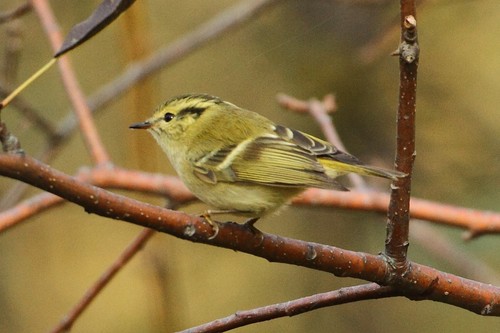
Lemon-rumped Warbler
Phylloscopus chloronotus
A tiny, restless gem of the Himalayas, the Lemon-rumped Warbler is famous for its vibrant yellow rump and energetic canopy acrobatics. Watch for its signature wing-flick as it migrates from high mountain peaks to cozy winter gardens.
Quick Identification
Size
Length: 9–10 cm (3.5–3.9 in); Weight: 5–7 g (0.18–0.25 oz)
Colors
Olive-green upperparts, pale yellowish-white underparts, distinct lemon-yellow rump, pale central crown stripe, and two yellowish wing-bars.
Key Features
- Striking lemon-yellow rump patch visible in flight
- Double yellowish wing-bars on dark wings
- Pale central crown stripe bordered by darker lateral stripes
- Restless wing-flicking behavior
When You’ll See Them
Geographic range
Where Does the Lemon-rumped Warbler Live?
The Lemon-rumped Warbler is native to the Asian continent, primarily inhabiting the majestic Himalayan mountain range. Its core range extends from northern Pakistan and India through Nepal and Bhutan, reaching deep into south-central China. As an altitudinal migrant, it breeds in high-elevation forests but moves to lower valleys across South Asia and parts of Southeast Asia, including Myanmar and Thailand, during the winter months.
Basemap © OpenStreetMap contributors
Behavior
The Lemon-rumped Warbler is a hyperactive, tiny songbird that rarely stays still for more than a second. It is a master of the forest canopy, frequently seen flitting through the leaves with a characteristic wing-flicking motion. This movement is thought to flush out small insects, which the bird then snaps up with precision. While they are solitary or found in pairs during the breeding season, they often join large, multi-species foraging flocks during the winter months.
These warblers are altitudinal migrants, meaning they spend their summers high in the mountains and descend to lower, warmer valleys and suburban gardens when the snow hits the peaks. Despite their small size, they are quite bold and will forage in garden shrubbery quite close to human dwellings, though they remain difficult to observe clearly due to their constant movement and preference for dense foliage.
EverydayEarth exclusive
Camera Tips
To capture the Lemon-rumped Warbler on an AI-powered camera, placement is everything. Because these birds are so small and move so quickly, a wide-angle trail camera might miss them entirely. Instead, focus your camera on a specific 'landing pad'—a thin, horizontal branch near a water source or a flowering shrub. Positioning your camera at a height of 5 to 7 feet will align better with their natural foraging height in garden settings.
One of the best lures for this species is a bird bath with moving water. The sound of a dripper or a small solar fountain is like a magnet for warblers. Ensure your camera is set to a high sensitivity with a fast trigger speed (0.2 seconds or less) to catch them before they flit away. If your camera allows for it, increase the shutter speed to 1/1000 or higher to freeze their rapid wing-flicks and reveal the distinctive yellow rump that gives them their name.
Lighting is also crucial. Try to place your camera so the sun is behind it, illuminating the bird's back and crown. This will make identifying the pale crown stripe and the double wing-bars much easier for both you and the AI. In winter, early morning is the peak time for activity as they are desperate to feed after a cold night; make sure your camera is positioned to avoid the harsh glare of the rising sun while still capturing the first activity of the day.
Similar Species
Species that look similar or are commonly confused with Lemon-rumped Warbler.
Frequently Asked Questions
Record Lemon-rumped Warbler at your habitat
Connect a camera to start building your own species record — AI identifies every visitor automatically.