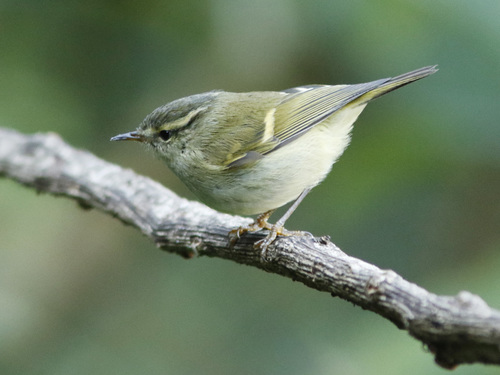
Buff-barred Warbler
Phylloscopus pulcher
A vibrant and acrobatic inhabitant of the Himalayan heights, the Buff-barred Warbler is famous for its distinct orange-tinted wing bars and energetic foraging style. This tiny mountain traveler is a master of the high-altitude canopy, flitting through rhododendrons with restless energy.
Quick Identification
Size
Length: 10 cm (4 inches); Wingspan: 14–16 cm (5.5–6.3 inches); Weight: 6–9 grams (0.2–0.3 oz)
Colors
Olive-green upperparts, yellowish-white underparts, bold yellow eyebrow, and two wing bars (lower bar is distinctively buff or orange-tinted).
Key Features
- Prominent buff-colored lower wing bar
- Bold yellow supercilium (eyebrow) and dark eye stripe
- White outer tail feathers visible during flight or tail-flicking
- Small, thin bill optimized for insects
When You’ll See Them
Geographic range
Where Does the Buff-barred Warbler Live?
Native to the majestic mountain ranges of Central and Southern Asia, the Buff-barred Warbler is a quintessential Himalayan species. Its core range spans the high-altitude forests of Nepal, Bhutan, and Northern India, stretching eastward into Western China. During the winter, populations are also frequently found in the highlands of Myanmar, Thailand, Laos, and Vietnam as they descend from the freezing peaks to find food in warmer valley thickets.
Basemap © OpenStreetMap contributors
Behavior
The Buff-barred Warbler is an exceptionally active and acrobatic bird, constantly on the move as it flits through the canopy of high-altitude forests. It is known for its restless energy, frequently flicking its wings and tail—a movement that often reveals the white outer feathers of its tail. While they are generally shy and prefer the cover of dense foliage, they can be quite vocal, making their presence known with a series of high-pitched, metallic 'tzit' calls.
During the breeding season, these warblers are found in pairs or small family groups, but in the winter, they often join mixed-species foraging flocks. These social groups help the small birds stay safe from predators as they move through the undergrowth. Despite their small size, they are hardy travelers, performing altitudinal migrations where they move thousands of meters down mountain slopes to escape the harsh Himalayan winters.
EverydayEarth exclusive
Camera Tips
Capturing the Buff-barred Warbler on an AI-powered camera requires speed and precision. Because these birds are 'leaf gleaners'—constantly moving and hovering near foliage—you should set your camera to its fastest trigger speed. If your device supports 4K video or a high-speed burst mode, enable it to ensure you catch a clear frame of the bird between its rapid hops. Position your camera at eye level near flowering rhododendrons or fruiting shrubs, which are magnets for the insects these warblers hunt.
A critical strategy for attracting this species is the use of water. Like many montane warblers, the Buff-barred Warbler is drawn to shallow, moving water for bathing and drinking. A birdbath with a small solar dripper or a recirculating 'mister' is far more effective than standing water. Place the camera 3 to 5 feet from the water source, angled slightly downward to capture the bird's white outer tail feathers as it splashes.
Since these birds spend much of their time in the mid-to-upper canopy, look for 'natural ladders' like low-hanging mossy branches or vine tangles where the canopy meets a clearing. Setting your camera at a height of 4 to 6 feet in these transitional zones is ideal. In the winter months, focus your efforts on gardens or forest edges at lower elevations, as this is when they are most likely to visit suburban or agricultural fringes in search of warmth and food.
Similar Species
Species that look similar or are commonly confused with Buff-barred Warbler.
Frequently Asked Questions
Record Buff-barred Warbler at your habitat
Connect a camera to start building your own species record — AI identifies every visitor automatically.