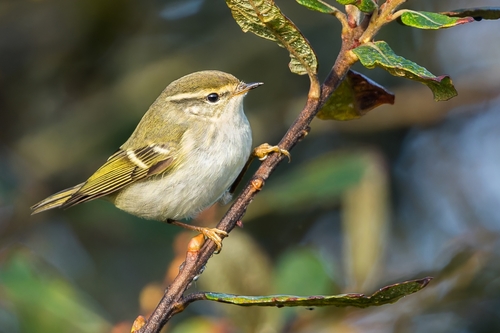
Yellow-browed Warbler
Phylloscopus inornatus
A tiny traveler from the Siberian wilderness, the Yellow-browed Warbler is a master of migration. Recognizable by its bright 'eyebrows' and restless energy, this vocal visitor is a highlight for backyard birders every autumn.
Quick Identification
Size
9–11 cm (3.5–4.3 in) long; 15–21 cm (6–8 in) wingspan; 4–9g (0.14–0.32 oz) weight
Colors
Olive-green upperparts and off-white underparts; features a prominent pale-yellow eyebrow (supercilium) and two distinct yellowish-white wing bars.
Key Features
- Bold pale-yellow supercilium (eyebrow) above a dark eye stripe
- Two distinct pale wing bars on the wings
- Bright olive-green plumage on the back and crown
- Restless, energetic movement with frequent wing-flicking
When You’ll See Them
Geographic range
Where Does the Yellow-browed Warbler Live?
Native to the vast Eastern Palearctic, the Yellow-browed Warbler breeds across the Siberian taiga, stretching from the Ural Mountains east to the Pacific coast. During the winter months, the majority of the population migrates to the tropical and subtropical forests of South and Southeast Asia, covering countries like Thailand, Vietnam, India, and Myanmar. Interestingly, it is a regular and increasing autumn visitor to Western Europe, where it has become a staple find for birders in the United Kingdom, Scandinavia, and the Low Countries during the late migration season.
Basemap © OpenStreetMap contributors
Behavior
While they are solitary during their long-distance migrations, they can occasionally be found in mixed-species foraging flocks during the winter, capitalizing on the 'safety in numbers' strategy to avoid predators while feeding. They are highly vocal birds; their presence is often announced by a loud, high-pitched 'tsooeet' call long before the bird itself is seen. Though not traditionally shy around humans, their small size and preference for elevated foraging spots make them a rewarding challenge for backyard observers.
EverydayEarth exclusive
Camera Tips
Technically, this species is a challenge because of its size and speed. Set your camera’s PIR (Passive Infrared) sensitivity to 'High' to ensure it triggers on such a small, lightweight subject. Use a fast shutter speed or a high frame rate (at least 30fps) to avoid motion blur, as their characteristic wing-flicking behavior can look like a smudge on slower cameras. If your camera settings allow, opt for a wide-angle view but place the camera within 3–5 feet of a specific branch to get enough detail to see the distinctive double wing bars.
Lighting is your best friend for identification. Position the camera facing north to avoid lens flare, ensuring the morning sun illuminates the foliage. This highlights the yellow-green contrast of their plumage, which is vital for the AI to distinguish them from common Chiffchaffs. While they won't come to seed feeders, maintaining a 'wild' garden area with native plants will attract the insects they need. During the peak migration window in late September or October, check your footage daily; look specifically for the energetic 'flitting' motion and listen for the piercing 'tsooeet' call if your camera records audio.
Similar Species
Species that look similar or are commonly confused with Yellow-browed Warbler.
Frequently Asked Questions
Record Yellow-browed Warbler at your habitat
Connect a camera to start building your own species record — AI identifies every visitor automatically.