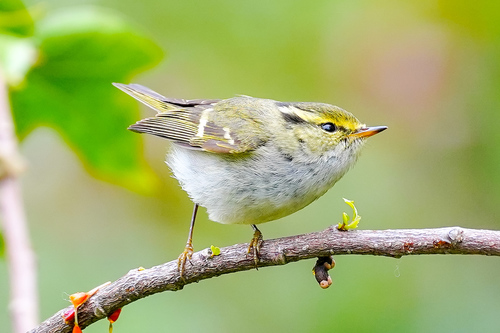
Pallas's Leaf Warbler
Phylloscopus proregulus
A tiny, vibrant jewel of the forest, the Pallas's Leaf Warbler is known for its brilliant yellow stripes and incredible hovering acrobatics. Though small enough to fit in the palm of your hand, this migratory marvel travels thousands of miles across the Asian continent every year.
Quick Identification
Size
9–10 cm (3.5–4 inches) long; wingspan 12–16 cm (4.7–6.3 inches); weight 4.5–7 grams (0.16–0.25 oz)
Colors
Olive-green upperparts with pale underparts; distinctive lemon-yellow rump patch, double yellow wing bars, and a bold yellow stripe through the center of the crown.
Key Features
- Bold yellow stripe down the center of the crown
- Bright yellow rump patch visible during flight or hovering
- Double yellowish wing bars on dark wings
- Extremely active, hummingbird-like hovering behavior
When You’ll See Them
Geographic range
Where Does the Pallas's Leaf Warbler Live?
The Pallas's Leaf Warbler is a native of the vast northern reaches of Asia, breeding primarily in the mountain forests of southern Siberia, northern Mongolia, and northeast China. During the winter months, these birds undertake a significant migration to their wintering grounds in southern China and the northern parts of Southeast Asia, including Vietnam and Thailand. While their core range is Asian, they are famous for appearing as rare autumn vagrants in Europe, where they are a highly sought-after sight for birdwatchers.
Basemap © OpenStreetMap contributors
Behavior
The Pallas's Leaf Warbler is a tiny dynamo, characterized by its restless energy and acrobatic foraging style. It is one of the smallest birds in the Palearctic, and its movement reflects its size; it rarely stays still for more than a second, constantly flitting between branches and hovering at the tips of leaves to snatch tiny insects. This hovering behavior is a key behavioral trait that distinguishes it from many other leaf warblers, making it look almost like a goldcrest or a tiny hummingbird as it feeds.
Socially, these birds are usually solitary or found in pairs during the breeding season, but they frequently join mixed-species foraging flocks during the winter or migration. While they aren't particularly afraid of people, their preference for high forest canopies and their rapid, erratic flight paths can make them difficult to observe without the help of a motion-activated camera or binoculars. Their song is surprisingly loud and complex for such a minute bird, consisting of a series of trills and whistles.
EverydayEarth exclusive
Camera Tips
To capture the Pallas's Leaf Warbler on a backyard or trail camera, you must focus on their love for high-energy foraging. These birds are rarely seen on the ground, so avoid low-level camera placements. Instead, mount your camera at eye level or higher, aiming it toward the outer 'drip line' of coniferous or broadleaf trees where the birds are most likely to hover while searching for aphids. If you have flowering shrubs or fruit trees that attract small gnats, these are prime locations for a camera setup during the spring and autumn migration.
Because this species moves with incredible speed, standard trail camera triggers may be too slow, resulting in a frame full of empty branches. Use a camera with a high-speed 'burst' mode or a pre-trigger buffer that captures the seconds immediately before the motion is detected. Setting your camera to record high-frame-rate video (60fps or higher) will allow you to slow down the footage later to see the bird's distinctive yellow rump and crown stripe, which are often just a blur to the naked eye.
Water is a major draw for this species. A raised birdbath equipped with a solar fountain or a 'mister' is one of the most effective ways to lure them down from the canopy into your camera's field of view. The sound of moving water is highly attractive to warblers. Ensure the camera is positioned to catch the light from behind you, as the brilliant yellow markings that define the Pallas's Leaf Warbler are best captured in bright, direct sunlight.
Similar Species
Species that look similar or are commonly confused with Pallas's Leaf Warbler.
Yellow-browed Warbler
Lacks the central yellow crown stripe and the bright yellow rump patch of the Pallas's.
Goldcrest
Similar size and activity, but has a plain face with a black-bordered orange or yellow crest and lacks the yellow wing bars and rump patch.
Lemon-rumped Warbler
Very similar, but typically has a paler, less distinct crown stripe and is found in different geographic regions of the Himalayas.
Frequently Asked Questions
Record Pallas's Leaf Warbler at your habitat
Connect a camera to start building your own species record — AI identifies every visitor automatically.