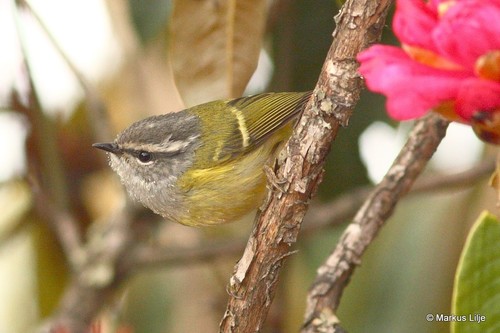
Ashy-throated Warbler
Phylloscopus maculipennis
A tiny, high-altitude specialist known for its distinctive ashy throat and energetic foraging style. This Himalayan gem is a favorite for birders looking to capture the beauty of Asia's montane forests.
Quick Identification
Size
Length: 9–10 cm (3.5–3.9 in); Weight: 5–7 g (0.17–0.25 oz)
Colors
Olive-green upperparts, distinct greyish-white (ashy) throat and breast, bright yellow rump patch, and yellow belly. Features a prominent pale eyebrow (supercilium).
Key Features
- Bright yellow rump patch visible during flight or wing-flicking
- Pale grey 'ashy' throat contrasting with a yellow belly
- Two pale wing bars, with the lower one being more prominent
- White-edged outer tail feathers seen when fanned
When You’ll See Them
Geographic range
Where Does the Ashy-throated Warbler Live?
The Ashy-throated Warbler is a specialist of the Asian highlands, primarily native to the Himalayan mountain range and the high-altitude forests of Southeast Asia. Its core range extends from northern Pakistan and India through Nepal and Bhutan, reaching into southwestern China. During the winter, populations in the northern reaches perform altitudinal migrations, moving down into the lower valleys of Myanmar, Thailand, Laos, and Vietnam to escape the harsh mountain cold.
Basemap © OpenStreetMap contributors
Behavior
The Ashy-throated Warbler is a quintessential 'leaf warbler,' characterized by its restless and high-energy personality. It is almost constantly in motion, flitting through the canopy and outer branches of trees to glean tiny insects from the undersides of leaves. It often performs short, hovering flights—a behavior known as 'hover-gleaning'—to snatch prey that other birds might miss. You will frequently see it flicking its wings, a motion that momentarily flashes its bright yellow rump.
These birds are highly social outside of the breeding season and are frequently found as 'nuclear' members of mixed-species foraging flocks. This means they often lead the movement of a group that might include titmice, fulvettas, and other warblers. While they are not particularly shy, their small size and preference for mid-to-upper canopy levels can make them a challenge to spot without a dedicated camera setup or binoculars.
EverydayEarth exclusive
Camera Tips
To capture the Ashy-throated Warbler, your camera needs a very fast trigger speed and a high frame rate. These birds are tiny and move with a 'nervous' energy, rarely staying in one spot for more than a second. Position your AI-powered camera near the outer branches of flowering shrubs or trees, as they prefer foraging on the periphery where insects are more active. A height of 5 to 8 feet is generally ideal for catching them as they move through the mid-story.
The absolute best way to lure this species into camera range is with a moving water feature. While they won't visit a seed feeder, the sound of splashing water from a solar fountain or a dripper is highly attractive to leaf warblers. Ensure the camera is angled to capture the bird at the edge of the water, and use a fast shutter speed setting to freeze their rapid wing movements, which is the only way to get a clear shot of their diagnostic yellow rump.
Lighting is critical for this species because their 'ashy' throat can easily appear as a dark shadow in poor light. Try to place your camera with the sun at its back (facing east for morning activity) to illuminate the subtle grey and yellow tones. In winter, focus your efforts on gardens with native evergreen plants, as these provide the necessary insect micro-habitats that keep these warblers returning to the same spot daily.
Similar Species
Species that look similar or are commonly confused with Ashy-throated Warbler.
Frequently Asked Questions
Record Ashy-throated Warbler at your habitat
Connect a camera to start building your own species record — AI identifies every visitor automatically.