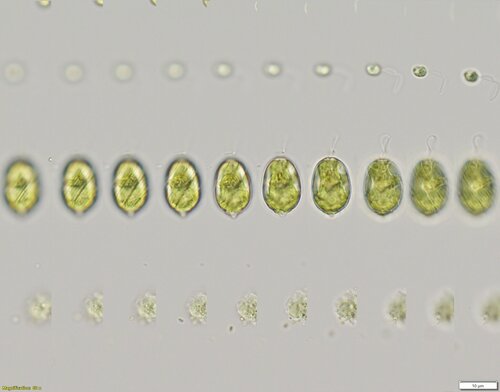
Lepocinclis ovum
Lepocinclis ovum
Peer into a drop of pond water and discover the emerald-green wonder of Lepocinclis ovum. This microscopic, egg-shaped powerhouse is a master of the backyard water world, spinning through its environment with grace and precision.
Quick Identification
Size
30–50 μm (0.0011–0.0019 inches) in length
Colors
Brilliant emerald green chloroplasts with a transparent, striated outer pellicle; often shows a reddish 'eyespot' near the anterior.
Key Features
- Distinctive oval or egg-shaped body that does not change shape
- Rigid outer pellicle with fine spiral striations
- Pointed, tail-like projection (cauda) at the posterior
- Single long flagellum used for swimming
When You’ll See Them
Behavior
Lepocinclis ovum is a captivating single-celled flagellate that bridges the gap between plant and animal life. Unlike its flexible cousins in the Euglena genus, Lepocinclis possesses a rigid pellicle, a proteinaceous outer layer that acts like a suit of armor. This means the organism maintains its perfect egg-like shape even as it maneuvers through dense aquatic debris. It moves through the water with a characteristic spiraling motion, propelled by a single flagellum that pulls the cell forward like a tiny airplane propeller.
As a mixotroph, Lepocinclis ovum is highly sensitive to light. It uses a specialized light-sensing organelle, often visible as a tiny red dot called a stigma or eyespot, to navigate toward optimal sunlight for photosynthesis. While they are solitary hunters of light, they are frequently found in high concentrations in healthy, nutrient-rich backyard ecosystems, particularly where organic decomposition is occurring. They play a vital role in the microscopic food web, serving as a primary food source for larger rotifers and ciliates.
EverydayEarth exclusive
Camera Tips
Documenting Lepocinclis ovum requires a departure from standard trail camera techniques, moving instead into the world of digital microscopy. To capture these 'backyard' residents, you will need a digital microscope or a microscope-mounted camera capable of at least 100x to 400x magnification. The best samples are found by taking a pipette and drawing water from the very bottom of a birdbath or near the submerged stems of pond plants, where organic matter and sunlight overlap.
When setting up your observation 'studio,' use a concave or hanging-drop slide rather than a standard flat slide. Because Lepocinclis ovum has a rigid, three-dimensional egg shape, a flat slide can restrict its movement or even rupture the cell. A deeper drop of water allows the AI-powered tracking on modern digital microscopes to better follow the organism as it spirals through the water column. Use a cool LED light source from below; traditional incandescent bulbs generate too much heat, which will quickly evaporate the water and kill the specimen.
For the most striking footage, adjust your camera to a high frame rate, ideally 60fps or higher. These organisms move surprisingly fast at high magnifications, and a standard 24fps video will often appear blurry. Look for the 'cauda' or tail-point and the spiral markings on the surface to confirm identification. If your camera has a 'darkfield' setting, use it; this will make the emerald-green chloroplasts glow brilliantly against a black background, creating a high-contrast image that is perfect for AI identification algorithms.
Similar Species
Species that look similar or are commonly confused with Lepocinclis ovum.
Frequently Asked Questions
Record Lepocinclis ovum at your habitat
Connect a camera to start building your own species record — AI identifies every visitor automatically.