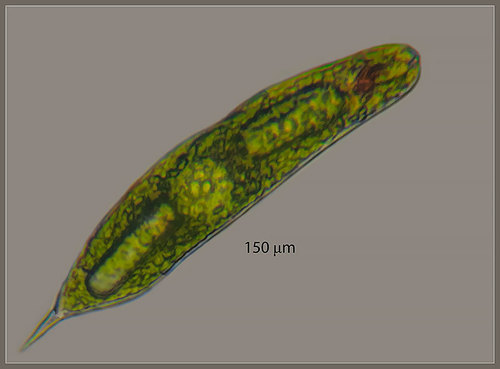
Lepocinclis oxyuris
Lepocinclis oxyuris
Step into the hidden world of the micro-wildlife in your backyard pond. Lepocinclis oxyuris is a stunning, needle-tailed marvel that powers itself with sunlight and swims with the grace of a miniature emerald javelin.
Quick Identification
Size
150–500 micrometers (0.006–0.02 inches) in length
Colors
Vibrant emerald green body with a translucent, needle-like tail; features a distinct bright red eyespot (stigma)
Key Features
- Large spindle-shaped body with a rigid outer shell
- Long, straight, and sharply pointed tail (cauda)
- Bright red eyespot located near the front
- Visible ring-shaped starch grains (paramylon) inside the cell
When You’ll See Them
Geographic range
Where Does the Lepocinclis oxyuris Live?
Where Does the Lepocinclis oxyuris Live? This species is a true global citizen, found in freshwater environments across every continent except Antarctica. It is particularly abundant in the temperate and subtropical regions of North America, Europe, and Asia, where it thrives in nutrient-dense ponds and agricultural waterways. Because it can form protective cysts to survive dry spells, its range extends even into ephemeral pools and seasonal backyard water features.
Basemap © OpenStreetMap contributors
Behavior
Lepocinclis oxyuris is a fascinating single-celled flagellate that acts as a 'giant' among the microscopic world. Unlike many of its cousins, this species possesses a very rigid outer membrane called a pellicle, which prevents it from changing shape as it moves. It swims through the water using a long, whip-like flagellum, often rotating its body in a graceful, corkscrew fashion. This movement is highly deliberate, as the organism uses its red eyespot to sense light levels and move toward the best areas for photosynthesis.
While primarily solitary, these micro-organisms can congregate in massive numbers in nutrient-rich backyard ponds, creating a green hue in the water. They are generally peaceful primary producers, but they also play a vital role in the ecosystem by absorbing dissolved organic nutrients. To the human eye, they are invisible or appear as tiny green specks, but through an AI-powered lens, they reveal a complex world of cellular activity and fluid motion.
EverydayEarth exclusive
Camera Tips
To capture Lepocinclis oxyuris, you will need to adapt your backyard setup for 'micro-wildlife.' Standard trail cameras won't see these organisms; instead, use a digital microscope camera or a high-magnification macro lens focused on a water-drop sample. Collect your sample from the surface of a pond or birdbath, specifically near floating vegetation or algae mats where these organisms congregate to maximize their sun exposure.
When setting up your digital camera for identification, use a high frame rate to capture their rotating swimming motion. AI-powered software identifies Lepocinclis oxyuris most effectively when the organism is viewed under 'brightfield' or 'oblique' lighting, which highlights the rigid, striated pellicle and the needle-like tail. A magnification of 100x is usually sufficient to see the movement, while 400x is required to see the internal paramylon rings and the red eyespot.
Place your sampling station in a sunlit area, as these flagellates are phototactic and will swim toward the light source. If you are using an automated backyard water monitor, ensure the intake is positioned in stagnant water rather than a running fountain, as Lepocinclis oxyuris prefers calm conditions. Summer is the best time for high-density captures, as 'blooms' occur when the water temperature rises above 20°C (68°F).
Similar Species
Species that look similar or are commonly confused with Lepocinclis oxyuris.
Frequently Asked Questions
Record Lepocinclis oxyuris at your habitat
Connect a camera to start building your own species record — AI identifies every visitor automatically.