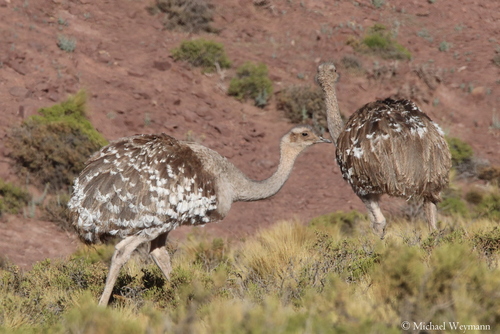
Lesser Rhea
Rhea pennata
Often called Darwin's Rhea, this flightless speedster is the spirit of the Patagonian wilderness. With its speckled plumage and incredible running ability, it is one of South America's most iconic avian residents.
Quick Identification
Size
90–100 cm (35–39 in) tall; weight ranges from 15–28 kg (33–62 lb)
Colors
Brownish-grey plumage heavily speckled with white-tipped feathers; underparts are pale white to buff.
Key Features
- Speckled white spots on brown-grey back and wings
- Feathers extend down the upper part of the tarsus (legs)
- Smallest of the rhea species
- Three large-toed feet built for high-speed running
When You’ll See Them
Geographic range
Where Does the Lesser Rhea Live?
Native to the southern half of South America, the Lesser Rhea thrives across the windswept Patagonian steppes of Argentina and Chile. One subspecies is also found much further north in the high-altitude Altiplano regions of the Andes, spanning parts of Bolivia, Peru, and northern Chile. These birds are specialists of open, arid environments where their camouflage blends perfectly with the low-growing scrub.
Basemap © OpenStreetMap contributors
Behavior
The Lesser Rhea is a highly social bird, typically found in groups ranging from 5 to 30 individuals. Outside of the breeding season, these mixed-sex flocks roam the vast steppes together. They are exceptionally fast runners, capable of reaching speeds up to 60 km/h (37 mph), which they use to outrun predators like pumas or Andean foxes. Despite being flightless, they use their large wings as rudders to execute sharp, high-speed turns while fleeing.
Interestingly, the Lesser Rhea exhibits a unique breeding system where the male takes on the bulk of parental duties. Males are highly territorial during the nesting season and will incubate a communal nest containing eggs from several different females. Once the chicks hatch, the father becomes fiercely protective, leading the brood and teaching them how to forage, while the females move on to find other mates.
EverydayEarth exclusive
Camera Tips
When setting up a camera for the Lesser Rhea, height is your most critical factor. Because these birds stand about a meter tall, your camera should be mounted roughly 18–24 inches off the ground. Angle the lens slightly upward if you are on a slope, but generally, a level shot captures their unique profile and the white spotting on their wings best. Since they are prone to running, place your camera in areas where they are forced to slow down, such as narrow passes between scrub bushes or near known water sources.
Lesser Rheas are creatures of habit and often use established trails through the steppe. Look for large, three-toed footprints or 'dusting baths'—depressions in the dry soil where they roll to clean their feathers. Positioning your camera near these dusting sites is a surefire way to get high-quality, stationary footage of their social behaviors and preening habits.
Because they are extremely fast, use a camera with a high-speed trigger (0.2 seconds or less) and set your capture mode to a 'burst' of 3-5 photos or a 15-second video. This ensures you catch more than just a passing wing or a blur. Early morning and late afternoon provide the best lighting, as the 'golden hour' sun makes the white tips of their feathers pop against the muted tones of the Patagonian landscape.
Similar Species
Species that look similar or are commonly confused with Lesser Rhea.
Frequently Asked Questions
Record Lesser Rhea at your habitat
Connect a camera to start building your own species record — AI identifies every visitor automatically.