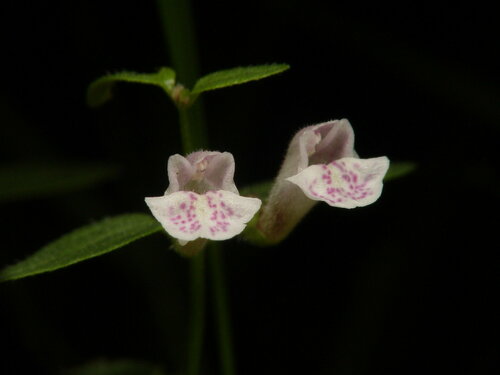
Lesser Skullcap
Scutellaria minor
A delicate gem of the marshlands, the Lesser Skullcap offers a masterclass in understated beauty. Its tiny, paired lilac blooms provide a splash of color to the damp, acidic soils where few other flowers dare to tread.
Quick Identification
Size
Reaches a height of 10–30 cm (4–12 inches); individual flowers are 6–10 mm (0.2–0.4 inches) long
Colors
Pale pink to lilac flowers, often with darker purple spots on the lower lip; dull green stems and leaves
Key Features
- Tiny pinkish-lilac flowers growing in pairs from leaf axils
- Square stems characteristic of the mint family
- Small, narrow, oval-shaped leaves with mostly smooth edges
- Compact, low-growing habit rarely exceeding 12 inches
When You’ll See Them
Behavior
Lesser Skullcap is a subtle but resilient perennial that thrives in the quiet, damp corners of the landscape. Unlike many showier wildflowers, it doesn't grow in massive, dense blankets; instead, it tends to weave itself through other wetland vegetation. It spreads primarily through underground rhizomes, allowing it to form stable colonies in suitable habitats over several years. During the winter, the plant dies back to the ground, with new growth emerging in late spring as the ground warms.
As a member of the Lamiaceae (mint) family, it has a structured growth pattern, but it lacks the strong aromatic scent associated with its cousins like peppermint or thyme. It plays a vital role in its local ecosystem by providing a nectar source for specialized long-tongued insects, particularly small bees and hoverflies, during the peak of summer when other wetland blooms might be fading. While it is harmless to humans, it is rarely used in modern herbalism compared to its larger relative, the Greater Skullcap.
EverydayEarth exclusive
Camera Tips
Capturing the Lesser Skullcap requires a different approach than fast-moving wildlife because of its small stature and specific habitat. Since this plant rarely exceeds 12 inches in height, you must mount your camera at ground level. A specialized 'spike' mount or a low-profile beanbag base is ideal. Angle the camera slightly upward to capture the interior of the hood-like flowers, which is where the most intricate markings are located. Because the flowers grow in pairs, try to profile the stem from the side to showcase this symmetrical growth habit.
The biggest challenge for your gear will be the environment. Lesser Skullcap loves 'wet feet,' meaning your camera will likely be sitting in mud or shallow water. Use a waterproof housing or place your camera inside a clear, heavy-duty dry bag with a hole cut for the lens, sealed with a rubber band. Don't forget to include a few silica gel packets inside the housing to prevent the lens from fogging up in the humid marsh air. If you are using a trail camera with a fixed focal length, you may need to use a 'macro' lens attachment or a close-up filter to prevent the plant from appearing as a green blur.
For the most engaging footage, set your camera to a 'Time-Lapse' mode rather than motion-trigger. Set the interval to one photo every 15–30 minutes during daylight hours. This will allow you to capture the slow unfolding of the blooms and the plant's phototropic movement as it leans toward the sun. If your camera allows for high-trigger sensitivity, you might also catch the occasional hoverfly or bee visiting the nectar-rich tubes. Early morning light (the 'golden hour') is best, as it highlights the fine hairs on the stem and the delicate texture of the lilac petals without the harsh shadows of midday.
Similar Species
Species that look similar or are commonly confused with Lesser Skullcap.
Frequently Asked Questions
Record Lesser Skullcap at your habitat
Connect a camera to start building your own species record — AI identifies every visitor automatically.