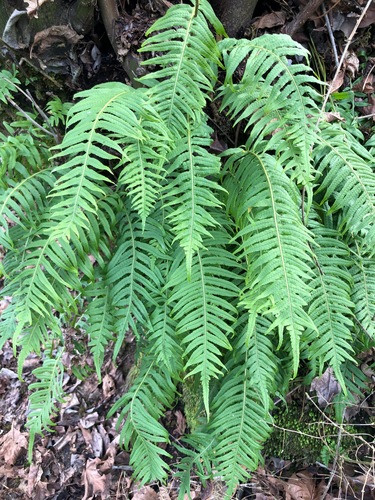
licorice fern
Polypodium glycyrrhiza
Transforming mossy branches into vertical emerald gardens, the licorice fern is the iconic winter greenery of the Pacific Northwest. Known for its surprisingly sweet roots and its habit of vanishing in the summer, it is a master of seasonal timing.
Quick Identification
Size
Fronds typically range from 10 to 70 cm (4 to 28 inches) long and up to 15 cm wide.
Colors
Bright to deep emerald green fronds with reddish-brown creeping rhizomes; undersides feature prominent orange or yellow circular spore cases.
Key Features
- Pointed, lance-shaped leaflets attached broadly to the stem
- Reddish-brown rhizomes with a distinct licorice flavor
- Circular orange spore cases (sori) arranged in rows on the leaflet undersides
When You’ll See Them
Behavior
The licorice fern is a unique "summer deciduous" plant, meaning it enters a period of dormancy during the dry summer months to conserve water. While most ferns are lush in the summer and die back in the winter, the licorice fern does the opposite. Its fronds typically brown and wither in July or August, only to spring back into vibrant, lush life with the arrival of the first heavy autumn rains.
This species often grows as an epiphyte, meaning it lives on the surface of other plants—most commonly the moss-covered branches of Bigleaf Maples and Red Alders. It doesn't steal nutrients from the trees but rather uses them as a high-altitude perch to reach better light and moisture. In some environments, it also thrives on wet, mossy rocks and logs, creating a "hanging garden" effect in the Pacific Northwest rainforests.
EverydayEarth exclusive
Camera Tips
Capturing the licorice fern on a backyard camera requires a shift in mindset from traditional wildlife photography. Since your subject is stationary, focus on "slow growth" storytelling. Mount your camera on a sturdy tripod or use a strap to secure it to a nearby branch, aiming specifically at a mossy limb where the fern is established. If your camera supports time-lapse mode, set it to take one photo every 6 to 12 hours starting in late September. This allows you to create a stunning video of the fern "waking up" as the autumn rains arrive and the fronds unfurl from their summer dormancy.
Lighting is the most critical factor for fern photography. Direct, midday sun can wash out the deep greens and create harsh shadows that obscure the delicate texture of the fronds. For the most saturated colors, rely on the soft, diffused light of overcast or misty days, which are common during the fern's peak season. If you are using a camera with an adjustable flash, try to disable it or use a diffuser; the natural sheen on the fronds can cause a "hot spot" reflection that ruins the image. Instead, utilize the "golden hour" just after sunrise for a warm, natural glow.
For those interested in the scientific side of identification, use a macro lens or the close-up setting on your trail camera. Position the camera to look at the underside of the fronds. This is where the "sori" (spore clusters) are located. Capturing these bright orange dots in sharp focus is a fantastic way to differentiate the licorice fern from similar species. Ensure your camera is angled slightly upward if the fern is growing on a high branch, as the drooping nature of the fronds often makes the underside more visible from below.
Lastly, remember that moisture is your friend for the subject but an enemy for the gear. While the fern looks best when glistening with raindrops, ensure your camera housing is fully waterproof and use a rain shield or a small overhang to prevent water droplets from sitting on the lens. A single drop of water on the lens can turn a beautiful shot of a lush fern into a blurry green smudge. Check the lens and wipe it with a microfiber cloth at least once a week during the rainy season.
Similar Species
Species that look similar or are commonly confused with licorice fern.
Frequently Asked Questions
Record licorice fern at your habitat
Connect a camera to start building your own species record — AI identifies every visitor automatically.